When the power drops, you need a safe way to move your essential loads over to a generator. The first fork in the road is whether you want the switch to change sources on its own or whether you're okay connecting the generator yourself at an inlet. That fork separates two very different products: a switching module that decides sources on its own and an inlet box you connect yourself. One is designed to ride along with a backup inverter or generator and decide which source feeds your loads; the other is an entry point that you plug into when an outage happens.
Quick verdict
Pick the Elecbee 63A Automatic Transfer Switch if you want automatic failover and a much lower price at $29.99. Pick the 20A Generator Transfer Switch Inlet Box if you want a hookup for a 125V NEMA 5-20P generator, and you're willing to pay $89.09.
Price and features at a glance
| Product | Price | Transfer type | Rating | Best for |
|---|---|---|---|---|
| Elecbee 63A Automatic Transfer Switch | $29.99 | Automatic | 63A | Generator/backup inverter switching with L1/L2 priority |
| 20A Generator Transfer Switch Inlet Box | $89.09 | Manual | 20A | Weatherproof NEMA 5-20P hookup for a 125V generator |
Where each product wins
The Elecbee wins for anyone who wants the transfer decision handled for them. It monitors the main source, moves to backup on its own, supports both 110V and 220V, and carries far more capacity than the inlet box. If you need a transfer switch that reacts without someone walking outside, this is the direction to look.
The inlet box wins for simplicity and convenience. It's a self-contained transfer switch with a prewired cord, pre-cut knockouts, a green power indicator, and an ETL listing. You just keep the box mounted and make the connection when needed.
Product notes
Elecbee Automatic Transfer Switch
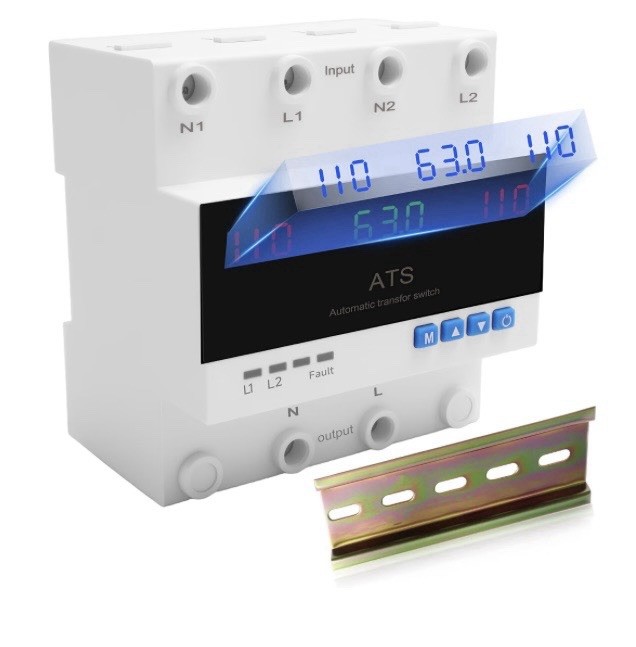
The Elecbee monitors the power source and moves to backup when the main source fails. You can set L1 or L2 as the priority source, adjust startup delay, transfer delay, and overcurrent value, and the guide-rail mount lets you install it on a DIN rail. It handles both 110V and 220V, making it flexible for different generator or inverter setups, and the PA6 V-0 flame-retardant housing is a plus. The trade-off is that this is a DIN rail module, so plan for a compatible enclosure, and the unit is sold as new-open-box, so give it a quick inspection before wiring. If you already have a panel or cabinet, the Elecbee gives you hands-free switching without standing at the box.
Generator Transfer Switch Inlet Box
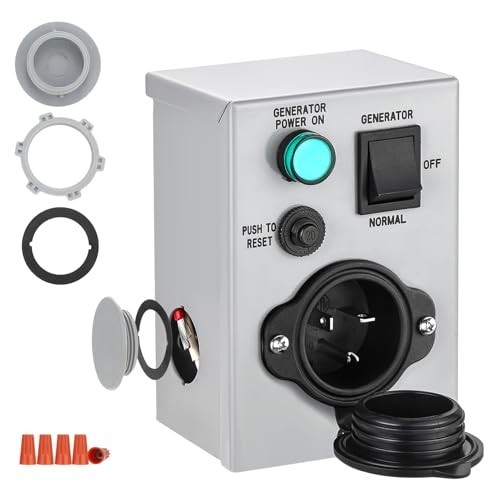
This inlet box is the more complete, no-module approach. It's a weatherproof enclosure that also works as a transfer switch, with a built-in circuit breaker and a prewired cord to simplify hookup. The green light on the lid gives a clear indication that the generator cord is connected, which is especially helpful in low light or at night. It's ETL-listed and designed for 3-prong generators in the USA and Canada. The drawback is that there's no automation-you have to go outside and plug in the generator manually. The load capacity is also smaller than the Elecbee's, so you'll want to keep it matched to modest loads. If you're after a straightforward outdoor connection point, this box handles it neatly, and the weatherproof housing means you don't have to add a separate enclosure.
Final choice by use case
Go with the Elecbee automatic transfer switch if you want failover and room to handle heavier loads. Choose the inlet box if you want a transfer point that you connect yourself. For an automatic, higher-capacity setup, the Elecbee is the clear match. For a simple connection, the generator inlet box is the one to install.