If you're teaching renewable energy to curious kids or tinkering at a workbench, one of the first decisions is whether a small wind micro hydro model can actually make the concept click without overcomplicating the lesson. Big turbines are expensive, noisy, and impractical indoors. A micro motor generator, on the other hand, promises a tangible way to show how moving air becomes electricity. But at $13.59, does the DIY Wind Turbine Micro Motor Generator deliver enough for classroom and home use? Here's a close look before you add it to your cart.
Who This Wind Micro Hydro Model Suits
This kit-style generator is clearly aimed at education, and the listed details support that. It's described as an ideal teaching tool for demonstrations, and its compact body-about 24mm in diameter-lets you set it up on a desk, tabletop, or small project board. If you're an educator, homeschool parent, or hobbyist who wants a low-cost way to demonstrate wind-to-electricity conversion, this model matches that purpose. Its 80mm fan diameter is small enough to be safe in a classroom but still visible enough for students to see the rotor spin.
What Stands Out From the Listed Details
One of the strongest selling points is the multiple voltage options listed: DC 3V at 1500 RPM, DC 4.5V at 2500 RPM, and DC 12V at 6500 RPM. That spread gives you flexibility to test how different input voltages change the generator's speed and output. For a lesson, that's a valuable experiment-students can measure how faster rotation affects the electricity generated. The vertical axis orientation also makes it different from many horizontal-axis hobby turbines, which could be a useful talking point about turbine design.
The quick-connect connector is another practical feature. It cuts down on soldering or wire twisting during class time, letting you focus on the demonstration rather than fumbling with leads. And the motor is marked with a silver finish, giving it a clean look for a display board.
Meaningful Trade-Offs
Before you commit, weigh the limitations. This is a micro motor, so it's not going to power lights, charge batteries, or run appliances. It's designed for demonstration and experimentation, not real-world energy generation. The line length is just 14cm, so you'll likely need your own wiring or a mounting setup for anything beyond a basic bench test. Also, the fan diameter of 80mm means it needs a steady, direct breeze to spin well-a fan or hair dryer might be required indoors, and natural wind may be too inconsistent.
The listed voltage specs are useful, but they don't tell you what the generator's peak power output is. That's not a dealbreaker for an educational tool, but it does mean you shouldn't expect any performance ratings for real-world loads. If your goal is a deeper electronics project involving battery charging or LED powering, you may need to pair this with additional components.
Product Note
DIY Wind Turbine Micro Motor Generator - Educational Model for Renewable Energy
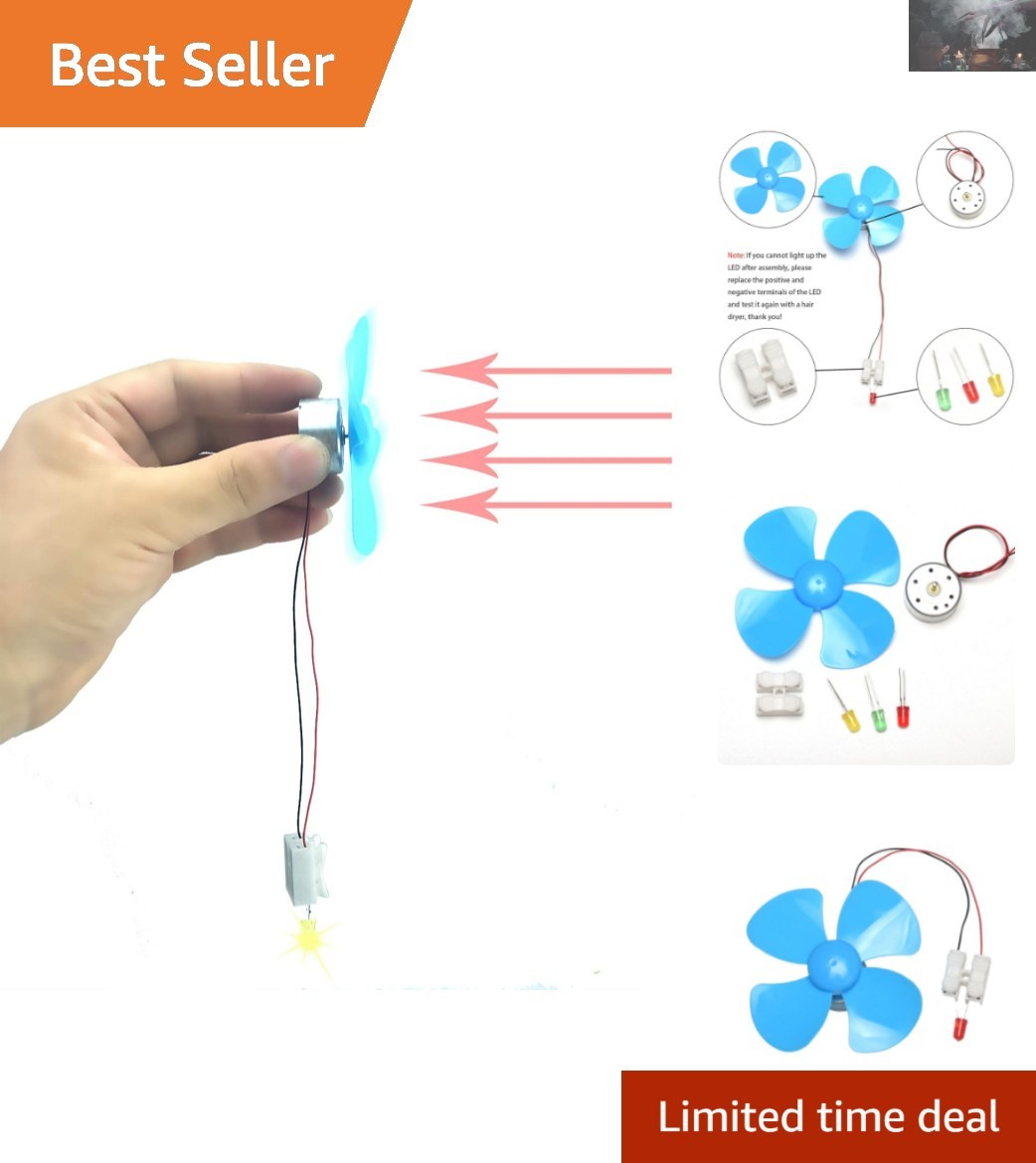
At USD 13.59, this is an affordable entry point for a hands-on renewable energy lesson. The vertical axis orientation and quick-connect connector make it easy to integrate into a classroom circuit or home experiment. The main limitation is its micro-scale size-it's built to teach principles, not to generate meaningful power. Choose it if your priority is an interactive demonstration of wind-to-electricity conversion; pass if you need something more substantial.
Bottom Line
The DIY Wind Turbine Micro Motor Generator is a practical, low-cost tool for making renewable energy tangible. Its compact design, multiple voltage settings, and straightforward connections fit well into educational settings, from elementary science lessons to hobbyist explorations. It won't replace a full-size turbine, but as a hands-on wind micro hydro model, it offers a solid way to see the basics in action-especially for the price. If your goal is to spark curiosity and demonstrate the mechanics of wind power, this generator is a reasonable pick.