Choosing a micro hydro generator for a home power system often comes down to whether a compact turbine and permanent magnet alternator can actually keep your battery bank charged without constant fuss. The Motenergy ME1016 with its matching Pelton wheel promises to handle 1-3 kilowatts, but the real question is whether the trade-offs fit your setup.
Quick Verdict
If you already have a three-phase rectifier and charge controller in your off-grid system, the Motenergy ME1016 with the ME0903 Pelton wheel is a straightforward way to convert falling water into battery charging current. At USD 249.00, it pairs a 12-cup die-cast aluminum Pelton wheel with a permanent magnet generator designed specifically for home power battery banks from 12 to 36 VDC.
Who It Suits
This set is aimed at DIY off-grid homeowners who have a consistent water source and a battery bank that needs steady charging. It is not a plug-and-play appliance. The generator is a three-phase AC unit, so you need to add your own three-phase full-wave rectifier to get DC output for charging. If you are comfortable with that extra component, this becomes a capable building block for a micro hydro system.
What Stands Out
The Pelton wheel uses die-cast aluminum cups-12 cups total-built for long service. The generator itself relies on ceramic magnets and achieves over 85% efficiency, which is notably better than the typical 60% efficiency of a standard car alternator. The wheel mounts directly onto the generator shaft, so there is no complicated coupling or gearbox to source. The intended output range of 1,000 to 3,000 watts gives you a flexible foundation for many off-grid battery banks.
Motenergy ME1016 Micro Hydro PMA Generator and Pelton Wheel
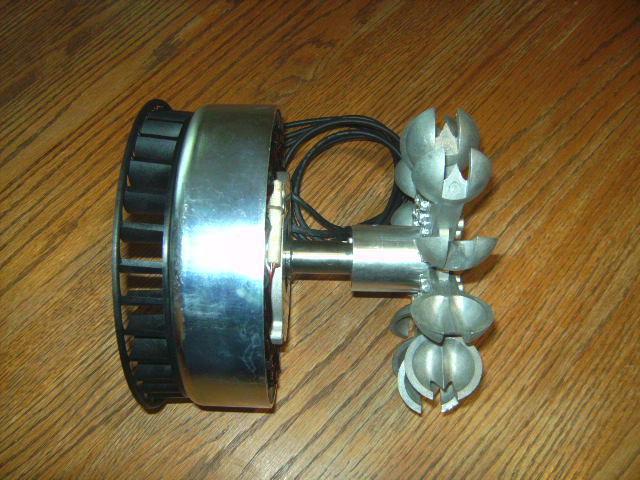
The listed set bundles the ME1016 PMA generator and the ME0903 Pelton wheel for USD 249.00. One concrete reason to choose it: the combination is deliberately matched to work together, so you avoid the guesswork of matching an unknown turbine to a generator. The ceramic magnets and 12-cup wheel are durable, low-maintenance parts for continuous use.
A concrete limitation to keep in mind is that the generator outputs three-phase AC, not DC. You must supply and wire your own rectifier bridge to convert it to charging voltage, and you will also want a charge controller between the rectifier and your battery bank. The description points you to three-phase rectifiers and charge controllers from companies like Coleman Air, but those are separate purchases.
Meaningful Trade-Offs
The biggest trade-off is added complexity. Because the generator is designed for 12-36 VDC after your rectifier, you need to be comfortable with both electrical wiring and system design. There is also no built-in rectifier or charge controller included in the price. On the other hand, that flexibility means you can tailor the output to your existing battery voltage rather than being locked into a fixed voltage.
Efficiency is a strong point, but remember that real-world output depends on your water head and flow. The 1k-3k watt range is a generator rating, not a guarantee of what your site will produce.
Bottom Line
The Motenergy ME1016 with the ME0903 Pelton wheel is a practical, efficient choice for off-grid battery charging if you already have or are willing to add a rectifier and charge controller. At USD 249.00, it offers a matched turbine and generator combination with strong efficiency and a wide output range. For DIY builders who enjoy tailoring their own hydro system, it is a solid foundation-just budget for the extra controller hardware and wiring.