Choosing a solar charge controller-the part of the solar BOS that sits between your panels and battery-usually comes down to a fork in the road: spend almost nothing on a basic regulator, or invest in a high-efficiency MPPT unit. The right call isn't about which one is 'better' on paper. It's about matching the controller to your solar array's voltage, current, and how much energy you actually need to harvest.
Quick verdict
If you just need to keep a small battery charged with a modest panel, the 10A PWM controller is the practical, low-stakes option. If you're building a larger off-grid system, the 60A MPPT controller can capture more energy from your panels when sunlight changes.
At a glance
| 10A PWM | 60A MPPT | |
|---|---|---|
| Price | $6.99 | $129.99 |
| Price bar | ||
| Charging mode | PWM | MPPT |
| Battery voltage | 12V/24V | 12V/24/36/48V |
| Application | Home, industrial, commercial | Home/garden, marine, shed |
Where each product wins
The 10A PWM wins when your biggest concern is protecting a battery at minimal cost. It also adds dual USB ports for direct phone charging. The 60A MPPT wins when you want to capture more solar energy over a wider voltage range, with room for higher panel input and larger battery banks.
Product notes
10A 12V/24V Solar Panel Battery Charge Controller LCD Auto Regulator Dual USB
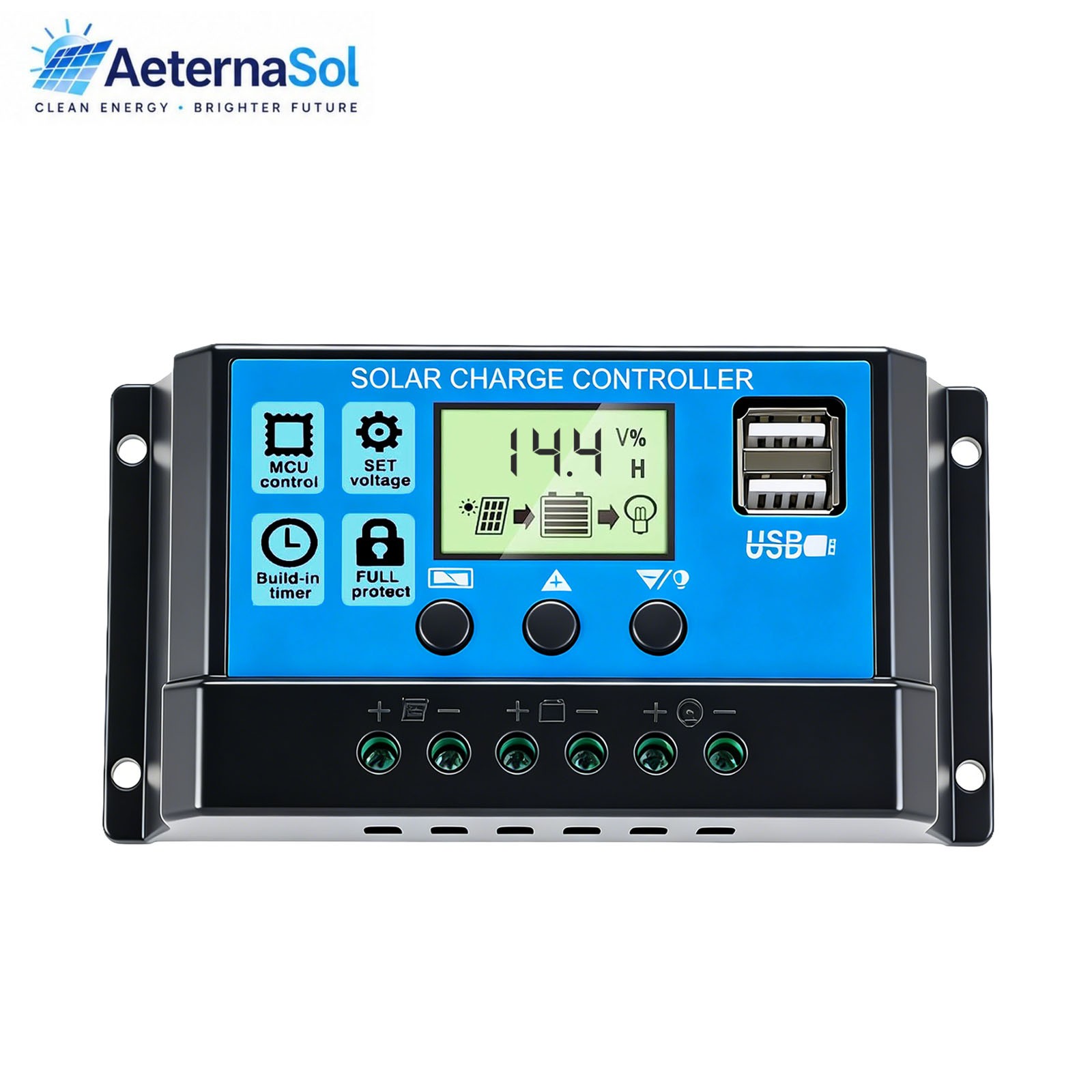
The 10A PWM controller keeps charging simple. It regulates charging for 12V or 24V batteries, and the LCD screen gives you status without an external meter. The dual USB ports are a real convenience-you can plug a phone or small device directly into the controller rather than adding a separate USB charger. It also includes short-circuit, open-circuit, reverse-polarity, and overload protection, and it prevents batteries from discharging back into the panel at night. The main limitation is the 10A rating: this is not a controller for a large solar array or for a higher-voltage battery bank. For home, industrial, or commercial applications, it prioritizes simplicity over raw capacity.
60A MPPT Solar Charge Controller for 12V/24/36/48V Battery Regulator Max.PV 200V

With a 60A rating and MPPT tracking, this controller is built for larger systems. Its MPPT algorithm continuously tracks the true maximum power point of the solar panels, so changing sunlight doesn't waste as much available energy. It works across a wide battery voltage range, and the maximum PV input of 200V gives you flexibility with higher-voltage solar arrays. The LED indicator makes status checks easy, and the metal case is a solid touch. The trade-off is capacity and cost: if your setup is a single small panel feeding a 12V battery, this controller is overkill. You're paying for a wide voltage range and high current output that you won't use until you expand.
Final choice by use case
For a simple small-scale setup with one panel and a battery bank, the 10A PWM controller is the sensible choice. For a larger off-grid build where you want to capture more energy from changing sunlight and have room to expand, the 60A MPPT controller is worth the higher price. Match the controller to the system you're actually building, not to the one you hope to have someday.