When you need AC power from a DC battery, choosing an inverter is less about chasing the biggest wattage number and more about matching the unit to your battery voltage and the equipment you plan to plug in. These two models take very different paths to the same job: one is built for multiple DC input voltages, and the other is a straightforward vehicle converter. The right pick depends on your battery bank, your loads, and how clean the power needs to be.
Quick verdict
If your loads are modest and your power source is a standard vehicle battery, the vehicle converter is the practical pick at $49.99. If you need cleaner AC power for sensitive electronics or a higher-voltage battery bank, the multi-voltage inverter is the stronger fit at $289.99.
At a glance
| 5000W Pure Sine Wave Power Inverter | 2000W Power Inverter | |
|---|---|---|
| Price | $289.99 | $49.99 |
| Output type | Pure sine wave | Modified sine wave |
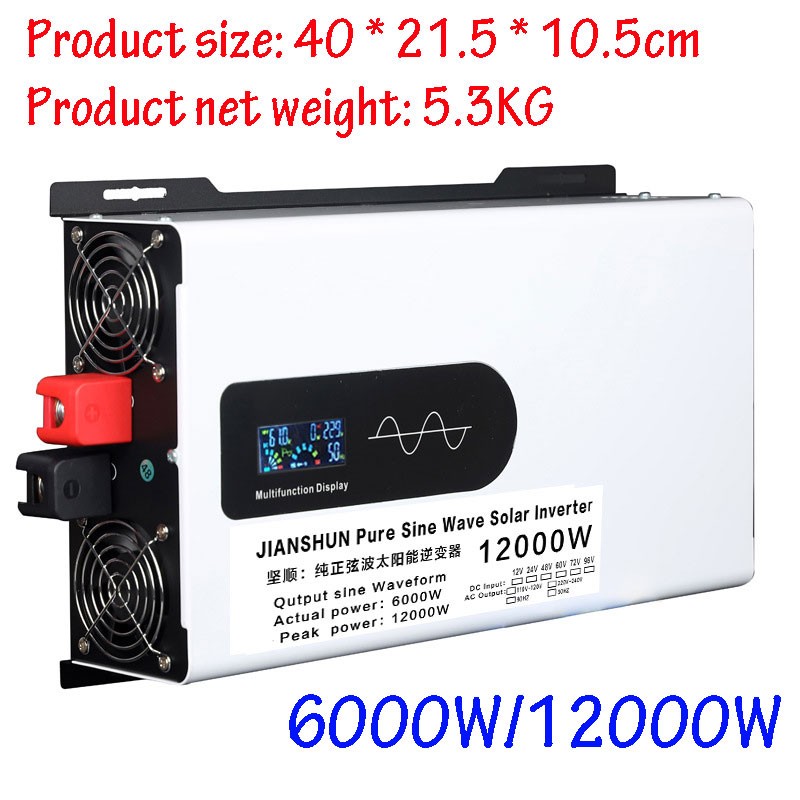
| DC input | 12V / 24V / 48V / 72V | 12V |
| AC output | 110V / 220V | 110V / 120V |
| Power capacity | Peak power options: 5000W, 8000W, or 12000W; rated power options: 2500W, 4000W, or 6000W | 2000W continuous, up to 4000W surge |
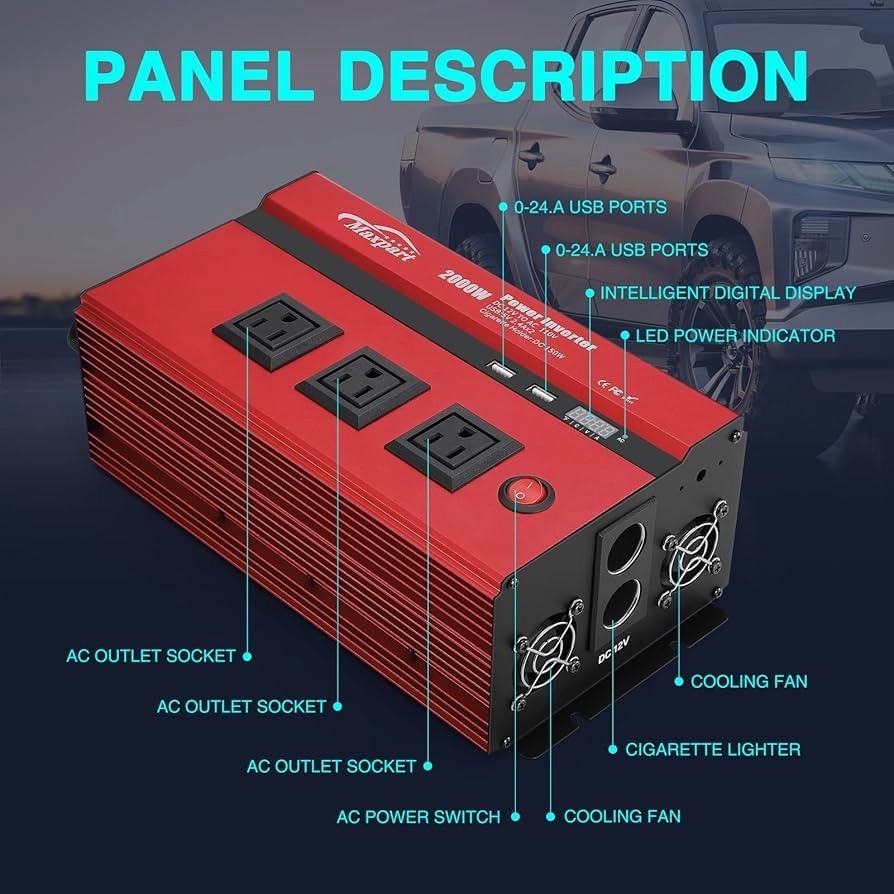
| Extra features | LCD display, smart module, temperature control, remote control | 3 AC outlets, 2 USB ports |
Where each product wins
- Choose the multi-voltage inverter when you need flexible input voltage options and higher peak capacity for bigger loads.
- Choose the vehicle converter when the job is straightforward vehicle power for everyday devices.
5000W Pure Sine Wave Power Inverter
The multi-voltage inverter is the more capable of the two when your power source is a higher-voltage battery bank. It accepts several DC input voltages and offers flexible AC output options. The clean AC output is the strongest reason to choose it if you plan to run sensitive electronics. The built-in LCD display, temperature control, and remote control add convenience at this power level. The limitation is that the model family has multiple peak and rated power variants, so you have to select the exact version that matches your battery bank and expected draw. The output voltage range also means the outlets need to match your region.
2000W Power Inverter
This inverter is aimed squarely at vehicle use: it is a 12V DC to 110V/120V AC converter for cars and trucks. Its main reason to choose it is the combination of 2000W continuous output with up to 4000W surge capacity, which gives you room to start motor-driven tools or appliances without immediately shutting down. It also includes three AC outlets and two USB ports, so you can run a laptop and charge phones from the same unit. The limitation is the modified sine wave output; if your gear requires a pure sine wave, this converter may not be a good match. It is also limited to 110V/120V output, so 220V-only equipment is out.
Final choice by use case
For a standard vehicle electrical system and everyday powered gear, the vehicle converter will likely cover most needs. For a larger off-grid or higher-voltage battery bank, or for equipment that is picky about power quality, the multi-voltage inverter is the model to buy.