Choosing an inverter for power conversion starts with one question: what DC power do you have, and what voltage do your appliances need? The 6000W 12V pure sine wave inverter and the ANENJI 6200W 48V solar hybrid take very different paths. The first is a battery-to-AC converter for standard household loads. The second is a 48V solar hybrid that can run on or off grid. This head-to-head covers the price, inputs, outputs, and use cases to help you decide.
Quick verdict
If you need a direct battery-to-AC converter and don't need a solar-system input, the 6000W 12V inverter is the simpler pick. If you're planning a solar installation and want a unit that manages more of the system, the ANENJI 6200W 48V solar hybrid is the stronger platform.
At a glance
| Feature | 6000W 12V Inverter | ANENJI 6200W 48V Solar Hybrid |
| Price | USD 37.39 | USD 282.00 |
| Battery input | DC 12V / 24V | 48VDC |
| AC output | AC 110V | 220/230V AC single phase |
| Included extras | LCD display, USB Type-C | WIFI dongle, dual AC output ports |
| Best fit | 12V systems with 110V loads | 48V solar or hybrid systems |
Where the 6000W 12V inverter wins
If you don't need solar charging and want a straightforward pure sine wave converter for standard household outlets, this unit keeps the connection path simple. It also includes protections for over-battery voltage, high and low input voltage, overheating, and short circuits.
Where the ANENJI 6200W 48V solar hybrid wins
If your plan includes a battery bank and solar panels, the ANENJI model pulls charging and monitoring into one unit. It has a built-in 120A MPPT charger controller, accepts PV input from 60Vdc to 500Vdc, and supports up to 9000W of PV array performance. It can run on or off grid.
Product notes
#### 6000W Pure Sine Wave Power Inverter DC12V to AC110V 3AC USB Type-C LCD Converter
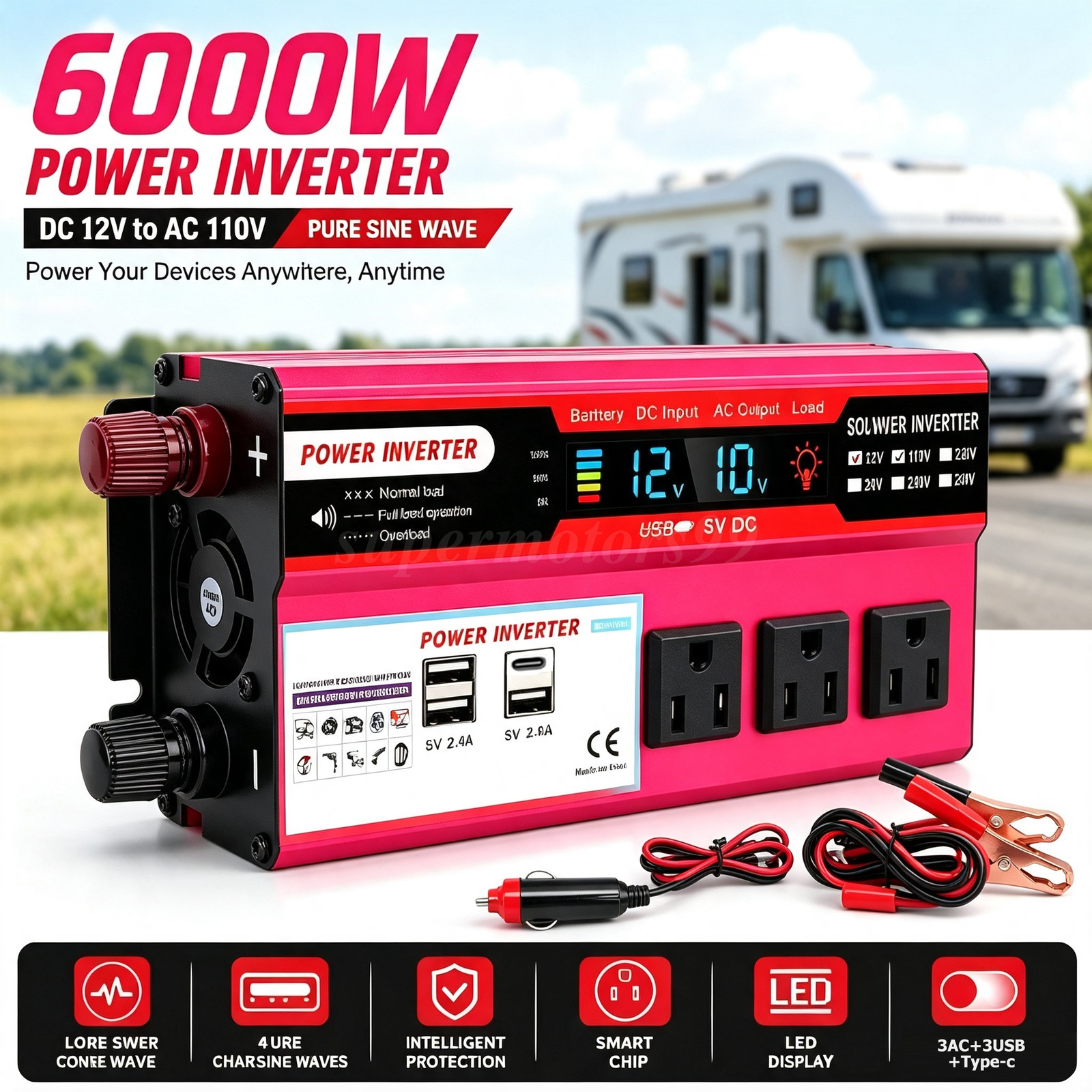
The main appeal of this 6000W inverter is how directly it fits a 12V or 24V system. You feed it DC from the battery, and it outputs pure sine wave AC for outlets, with a USB Type-C port and LCD readout for convenience. The built-in protections cover over-battery voltage, overheating, and short circuits, so it feels thought out for a compact power conversion package. The trade-off is the output voltage: it is fixed to one AC standard, so it is not built for 220/230V loads. If your loads are built for that output and your battery is 12V or 24V, this is the simpler route.
#### ANENJI 6200W 48V Solar Hybrid Inverter On/Off Grid Pure Sine Wave 120A MPPT PV 9000W
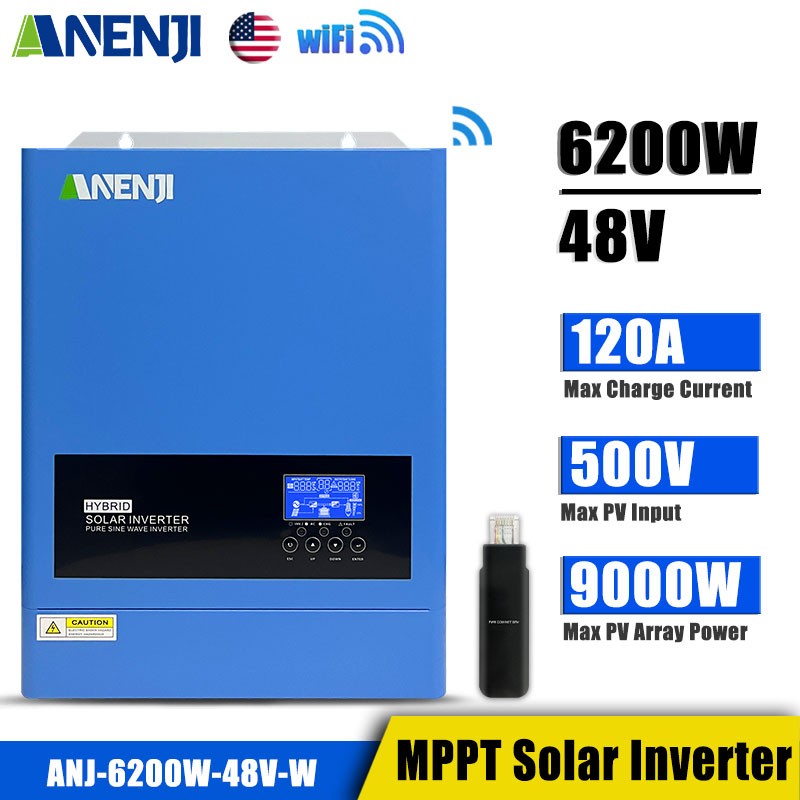
The ANENJI 6200W hybrid is engineered around a 48VDC battery and a wide PV input range of 60Vdc to 500Vdc. The built-in 120A MPPT charger controller handles solar charging, and the unit supports both lead-acid and lithium batteries, including lithium activation. Dual AC output ports give flexibility for connecting loads, and the WIFI dongle enables remote monitoring. It also lists 96% peak efficiency, which matters when managing larger power flows. The limitation is that the AC output is 220/230V single phase, so 110V appliances need an external step-down transformer. If you are building a 48V solar system and want charging, monitoring, and inverter functions in one box, this is the stronger fit.
Final choice by use case
Pick the 6000W 12V inverter when you want a direct battery-to-AC converter and your loads match its output voltage. Pick the ANENJI 6200W 48V solar hybrid when you are setting up a solar system. The price gap between the two reflects their different roles: one is a direct converter, and the other is a solar-management hub.