Need an inverter for a vehicle battery or a solar off-grid bank? These two pure sine wave inverters look related because both carry a 6000W class rating, but they are not interchangeable. The first feeds 110V loads from a 12V/24V DC supply; the second delivers 220V from a solar off-grid system. The real decision is the voltage pair your installation already uses and the peak power your loads demand.
Quick verdict
The 6000W DC12V-to-AC110V inverter is the straightforward pick for a vehicle or trailer setup with 110V appliances. The 6000W/12000W 48V-to-220V solar inverter is the stronger match for a solar off-grid system that needs 220V output and extra surge capacity. Both produce a pure sine wave and include short-circuit protection, so the choice comes down to input voltage, output voltage, and peak wattage.
At a glance
| Compare | 6000W DC12V to AC110V Inverter | 6000W/12000W 48V to 220V Solar Inverter |
| Price | USD 37.39 | USD 289.99 |
| DC input | DC 12V / 24V | DC 48V (48V-59V operating range) |
| AC output | AC 110V | AC 220V through US socket |
| Output frequency | 60+/-3Hz | 60Hz |
| Continuous / peak | 6000W RMS / 6000W peak | 6000W rated / 12000W peak |
| Protections | Short circuit, overheating, high/low voltage input, over-battery voltage | Low voltage, open circuit, overcurrent, overload, overvoltage, short circuit |
Where each product wins
Where the 6000W DC12V to AC110V inverter has the edge
- It fits installations that already run on 12V or 24V batteries and need 110V AC.
- Its continuous output equals its peak output, so the 6000W rating is the useful planning number.
- It is a simpler match for vehicle and trailer wiring where 12V is already present.
Where the 6000W/12000W 48V to 220V solar inverter has the edge
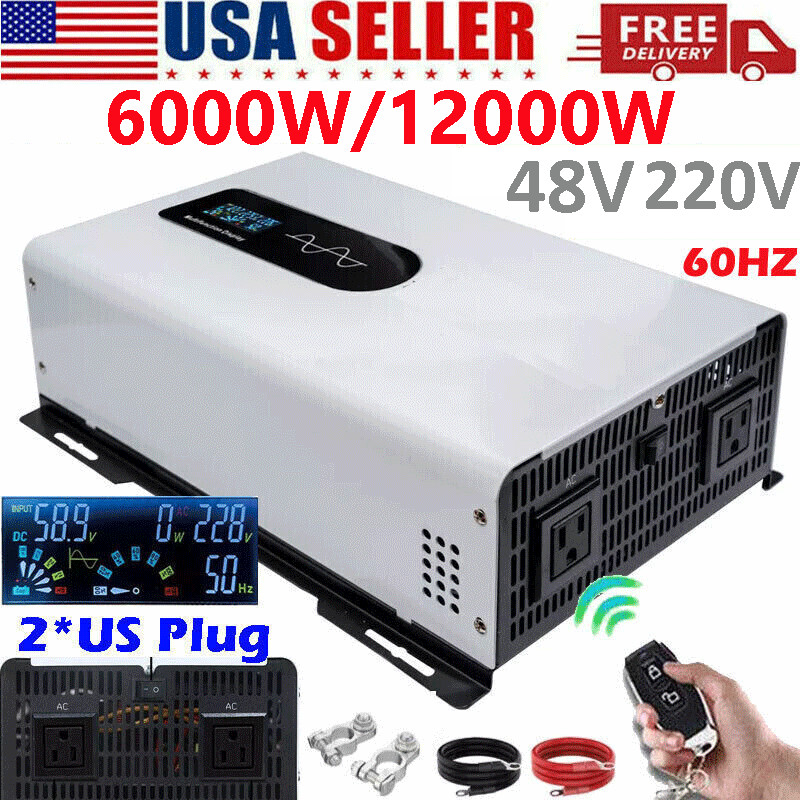
- It fits solar off-grid systems that need 220V AC.
- It separates rated power from peak power, giving more room for startup surge.
- The higher peak rating is the main reason to step up to this end of the price range.
Product notes
6000W DC12V to AC110V Power Inverter
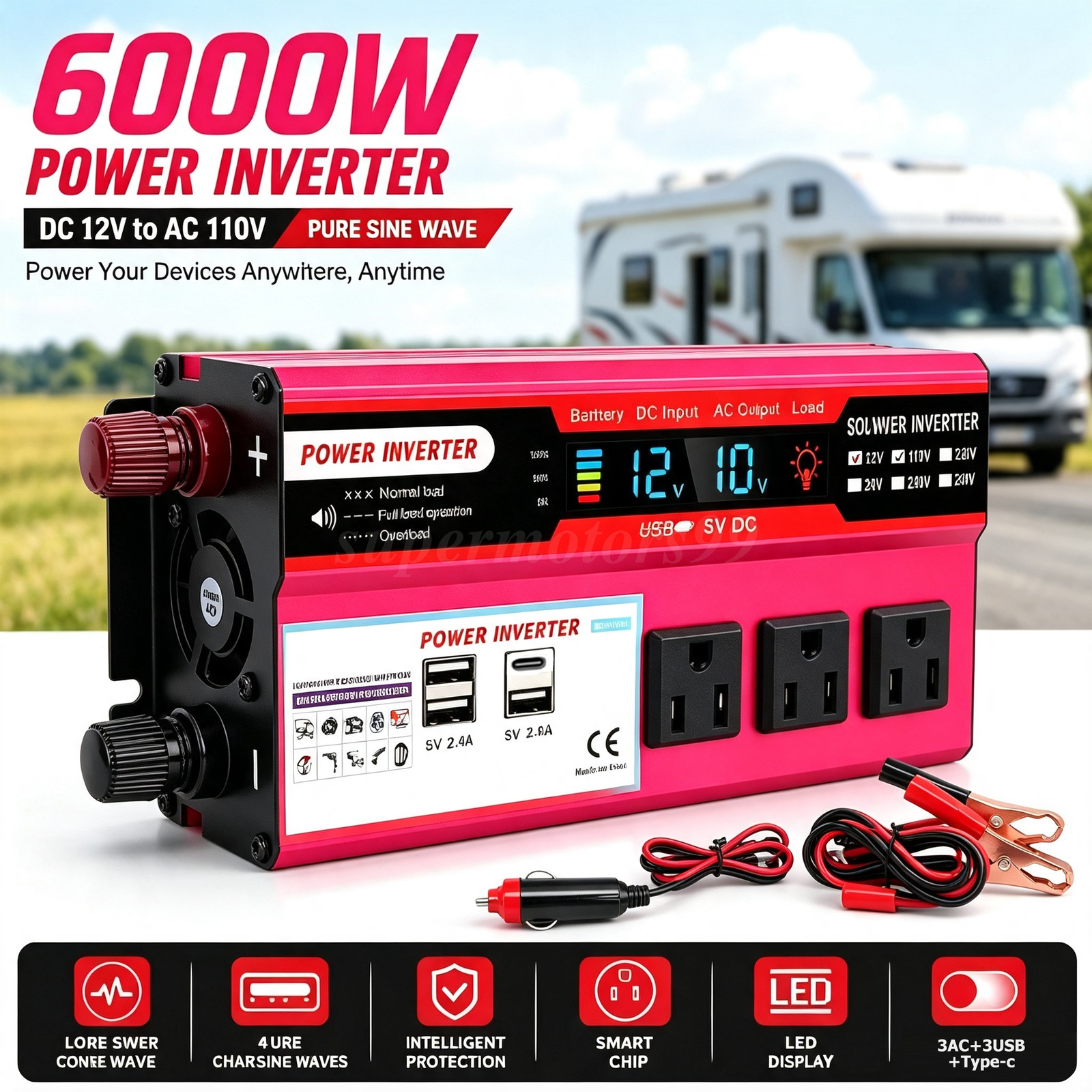
This inverter is a direct match for a 12V/24V battery that needs to feed 110V equipment, and the title points to a 3AC USB Type-C LCD converter, so USB-C and LCD elements are part of the package. The more important number is power balance: peak power is 6000W and RMS power is also 6000W, which means you should plan around 6000W continuous rather than counting on extra surge margin. For a vehicle, trailer, or small off-grid power setup already wired for 12V, this is an easy fit. If your battery bank runs at 48V or your devices expect 220V, this unit will not be able to serve them.
6000W/12000W 48V to 220V Solar Inverter
This inverter is aimed squarely at a 48V solar off-grid system. It accepts 48V DC with an operating range of 48V-59V and delivers 220V AC at 60Hz through a US socket, so the whole power chain is built around a 48V battery bank and 220V loads. Rated power is 6000W, but peak power is 12000W, giving equipment room for startup surge. It also includes an LCD display, temperature control, smart module, and remote control, with output efficiency at 90%-95%. The limitation is narrow compatibility: it will not take a 12V or 24V input, and the output stays at 220V, so it is not a general-purpose replacement for a 110V inverter.
Final choice by use case
Pick the 6000W DC12V to AC110V inverter when your battery bank is 12V or 24V, your devices run on 110V, and the $37.39 listed price fits your project. It gives you a pure sine wave and a USB-C connection without asking you to change your electrical system.
Pick the 6000W/12000W 48V to 220V solar inverter when you have a solar bank, need 220V output, and want the $289.99 listed price that also brings 12000W peak power. If your system voltage and appliance voltage are already fixed, the decision is made by those voltages.