Choosing the right inverter for your solar setup is about matching the unit to your loads and your grid situation. In the inverters power conversion space, two 48V pure sine wave options are easy to compare: the 6000W 12000W Pure Sine Wave Inverter at $289.99 and the 6200W 48V Hybrid Solar Inverter at $367.50. The $77.50 gap between them buys a very different feature set. Both convert 48V DC battery power into AC power, but the 6000W model is a dedicated off-grid unit, while the hybrid adds on/off-grid flexibility and MPPT charging.
Quick verdict
Pick the 6000W 12000W Pure Sine Wave Inverter if you want the lower price and need one high-power outlet from an off-grid 220V system. Pick the 6200W 48V Hybrid Solar Inverter if you need a solar charger, on/off-grid operation, and multiple outputs.
At a glance
| Feature | 6000W 12000W Pure Sine Wave Inverter | 6200W 48V Hybrid Solar Inverter |
| Price | $289.99 | $367.50 |
| Battery input | 48V DC | 48V DC |
| Rated power | 6000W (12000W peak) | 6200W |
| Output | 220V, 60Hz, US socket | 220/230V AC |
| Waveform | Pure sine wave | Pure sine wave |
| Charger | Built-in charger/inverter | MPPT 120A charger controller |
| Outputs | Single US socket | Dual outputs |
| Efficiency | 90%-95% | Up to 96% peak |
| Notable extras | LCD, smart module, temperature control, remote control | LCD, lithium battery activation, RS485 LifePO4 communication, EQ function, removable dust cover |
Where each inverter wins
The 6000W unit wins on price and surge capability. It costs less, still delivers 6000W continuous, and its 12000W peak is useful for starting motors or running appliances with a heavy initial draw. The 6200W hybrid wins on energy management. Its MPPT 120A charger pulls more solar power into the battery, hybrid mode lets you combine grid and solar, and dual outputs let you split loads. The unit can even operate without a battery and communicates with LifePO4 batteries over RS485.
Product notes
6000W 12000W Pure Sine Wave Inverter
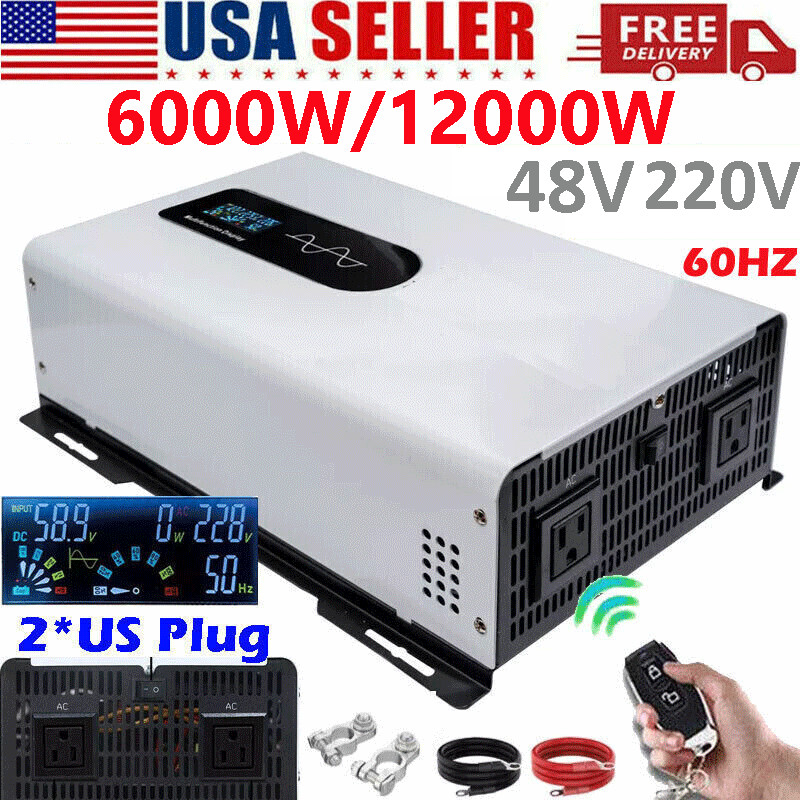
If a US socket and high peak power are your priorities, this inverter delivers a clean pure sine wave from a battery bank, with an LCD and remote control included. Its protection list covers low voltage, open circuit, overcurrent, overload, overvoltage, and short circuit, so the unit shuts down safely under many fault conditions. Its main constraint is the single US socket and the 220V output: you'll be powering one high-voltage appliance at a time rather than a full set of 120V loads. That makes it a good fit for a cabin, workshop, or backup setup where simplicity matters more than multi-output flexibility.
6200W 48V Hybrid Solar Inverter
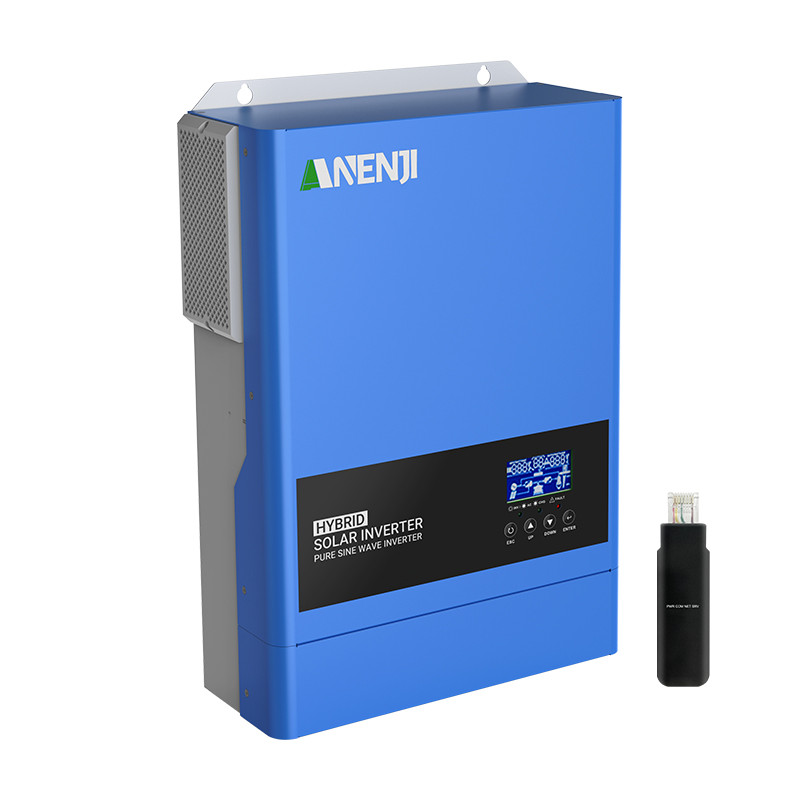
The ANENJI hybrid is the more flexible choice at $367.50. It combines a 6200W pure sine output with an MPPT 120A charger, works in both on-grid and off-grid systems, and provides dual outputs for separate circuits. Extras like lithium battery activation, RS485 LifePO4 communication, an EQ function, and a removable dust cover make it especially good for lithium-based solar storage. The removable dust cover is a small touch that helps when installed in a garage or garden environment. The trade-offs are the higher price and the 220/230V output aimed at EU systems; if you're in a 110V region, you'll need a step-down transformer.
Final choice by use case
For a budget-conscious off-grid installation with a single high-power outlet, the 6000W 12000W inverter gives you the lower price and extra surge headroom. For a home or garden setup that needs maximum power flexibility and advanced solar battery management, the 6200W hybrid is the more complete tool. If you already have a separate solar charge controller, the lower-priced unit may be all you need. If you want to consolidate that function into the inverter, the higher-priced hybrid simplifies the install.