Choosing an inverter for a camper, vehicle, or solar setup usually comes down to one question: can it take your battery voltage and deliver clean AC power at a price that makes sense? These two pure sine wave inverters answer that question differently. The 7000W Pure Sine Wave Power Inverter keeps the cost down for 12V users, while the Pure Sine Wave 8000 Watt Power Inverter offers a higher wattage headline and more flexible input options.
Quick verdict
If your battery bank is 12V and you want pure sine wave output without stretching your budget, the 7000W model is the straightforward pick. If you need higher continuous output for a solar system or want the ability to switch between 12V and 24V inputs, the 8000W model earns the extra spend.
At a glance
| Product | Listed price | Price bar | DC input | Display and charging | Notable specs |
|---|---|---|---|---|---|
| 7000W Pure Sine Wave Power Inverter | USD 43.39 | DC 12V | LCD and USB Type-C | 95% conversion efficiency, overheat/short/reverse/low-voltage protection | |
| Pure Sine Wave 8000 Watt Power Inverter | USD 98.70 | DC 12V / 24V auto-detect | Color LCD and USB/Type-C fast charging | 4000W continuous output, 50/60Hz switching, DSP-cooled fan |
Where each product wins
The 7000W model wins on listed price: it is USD 55.31 less than the 8000W unit. It also brings pure sine wave conversion and named protections for over battery voltage, high voltage input, overheating, reverse polarity, short circuit, and low voltage input.
The 8000W model wins on input flexibility and sustained output. Its DC input is listed as 12V/24V with auto-detection, and it supports 50/60Hz output switching. It also lists 4000W of continuous output, which makes it the stronger option for solar-system use and larger battery banks.
Product notes
7000W Pure Sine Wave Power Inverter (DC12V to AC110V)
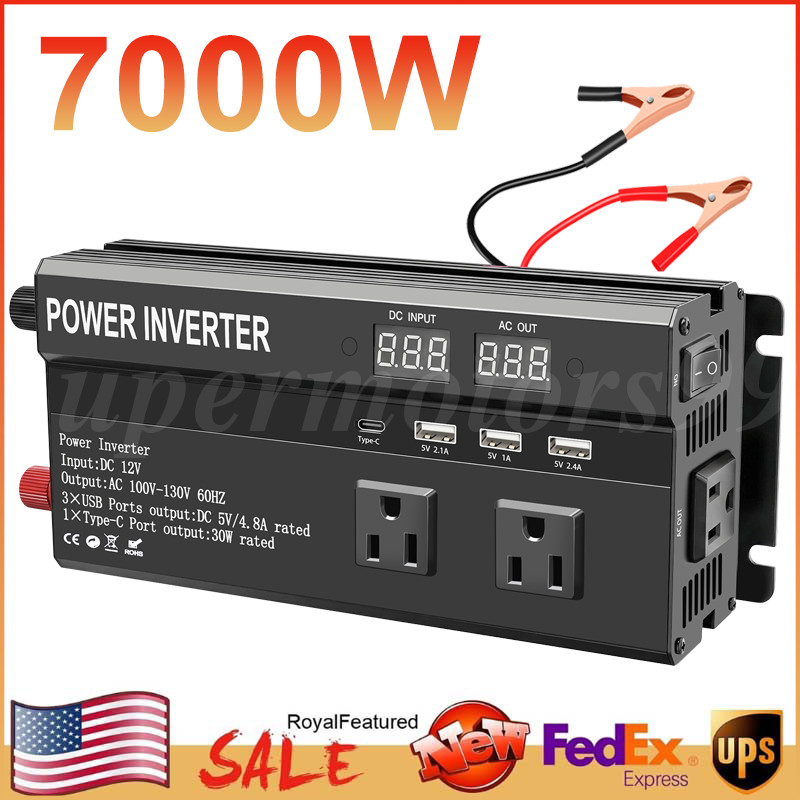
The 7000W model is the lower-priced choice in this pairing, and the name specifies 3AC output, USB Type-C, and LCD. It delivers pure sine wave output and converts 12V DC to 110V AC. Its protection list is broad for the price, covering over battery voltage, high voltage input, overheating, reverse polarity, short circuit, and low voltage input. If you already have a 12V battery setup and want a simple way to power 110V devices, this model gives you the core feature set. The limitation is its input voltage: the listed input is DC 12V only, so a 24V battery bank is outside its range.
Pure Sine Wave 8000 Watt Power Inverter (DC12V to AC110V-120V)
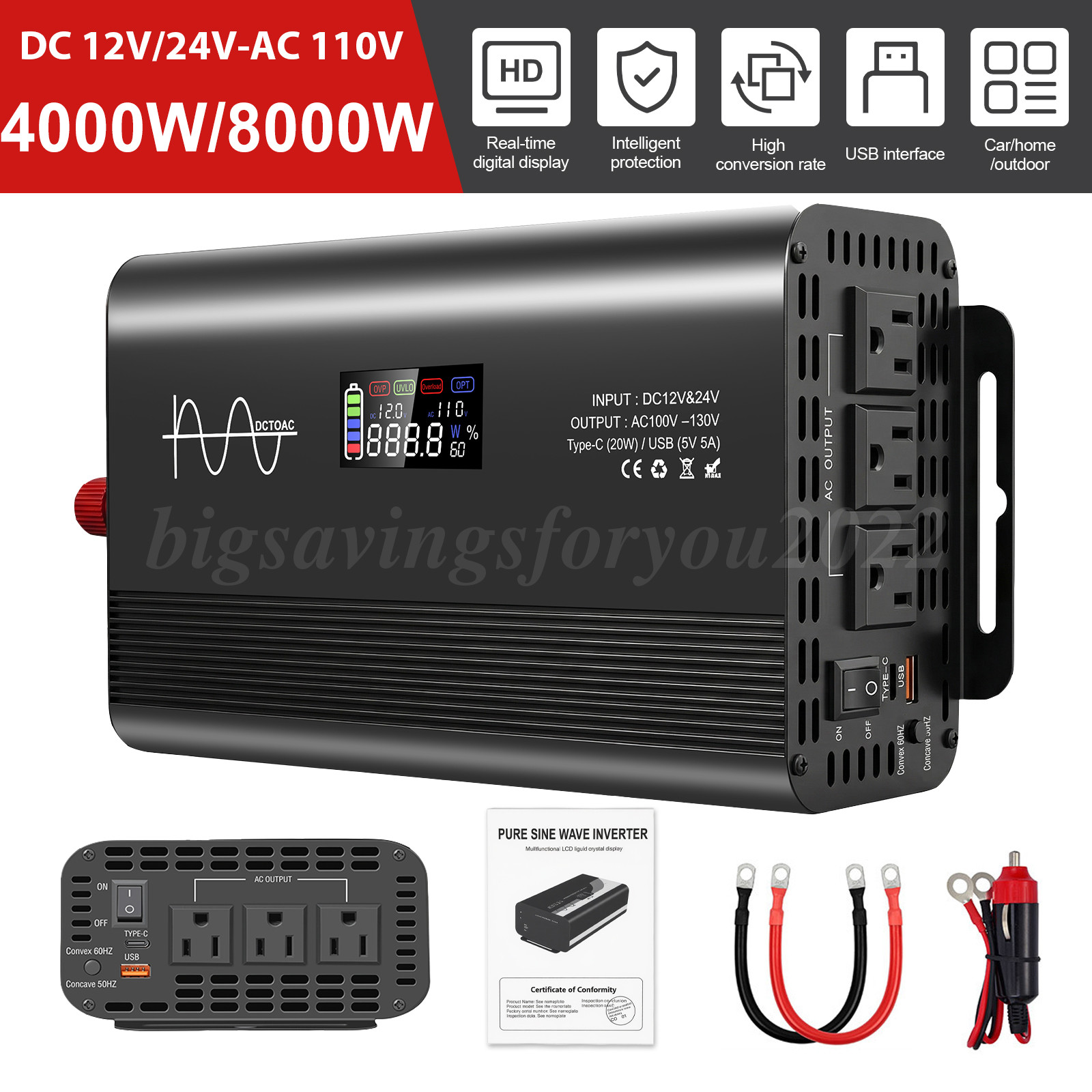
This is the higher-priced inverter, but it brings more to the table for flexible installations. It supports DC 12V/24V input with auto-detection, which removes the guesswork when you switch battery banks. The unit also supports 50/60Hz output switching, a smart color LCD, Type-C and USB fast charging, and a DSP-controlled cooling fan. It is aimed at camping, RV adventures, and home emergencies, with solar-system use indicated in the product name. The trade-off is the higher listed price: if you don't need 24V input or the 4000W continuous output, you may be paying for capability you won't use.
Final choice by use case
Choose the 7000W Pure Sine Wave Power Inverter if your battery bank is 12V and you want the lower listed price with pure sine wave output. Choose the Pure Sine Wave 8000 Watt Power Inverter if you need the higher continuous output and plan to use 12V or 24V battery setups, especially for a solar system.