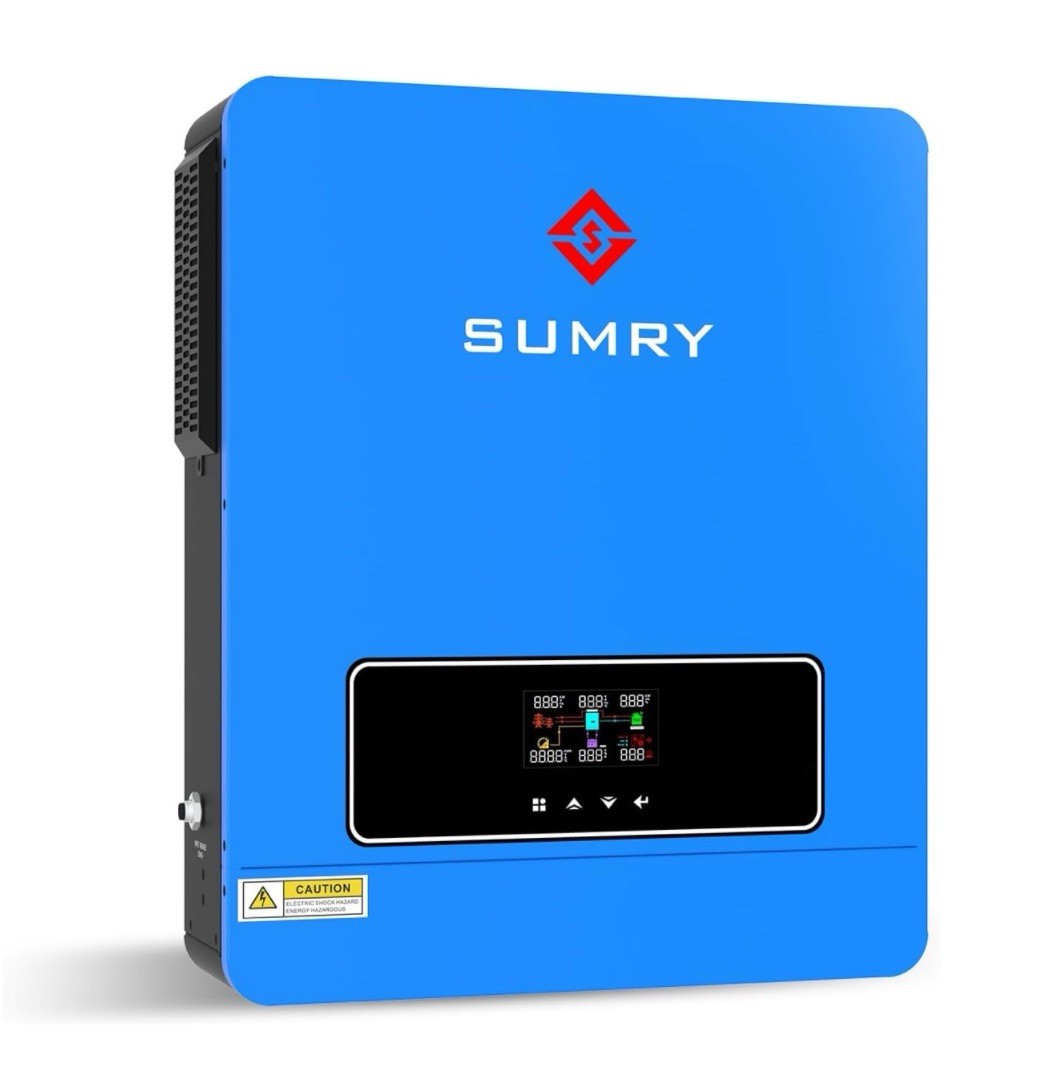
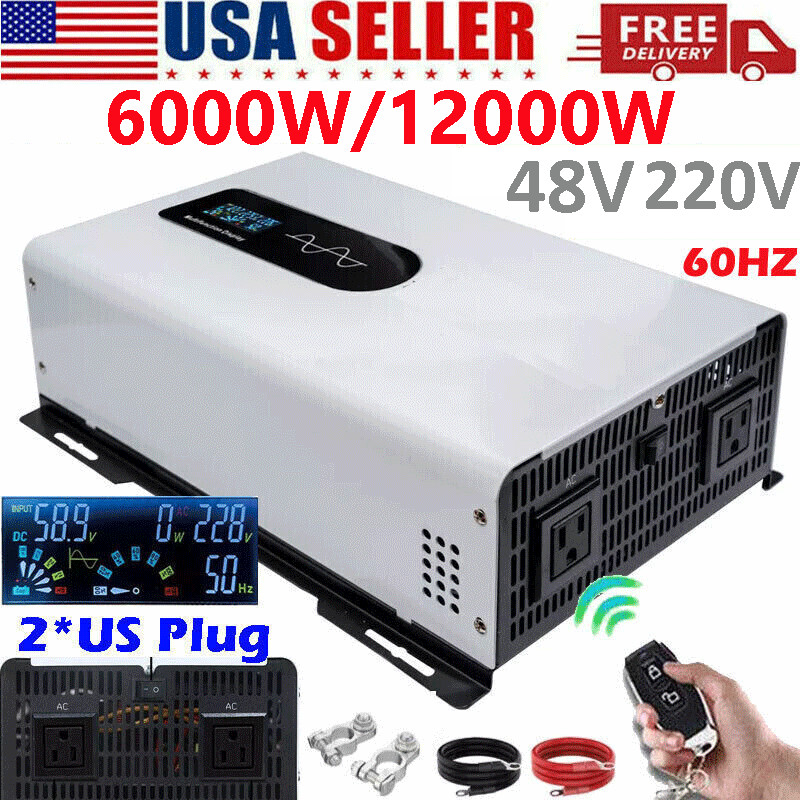
Choosing between inverters for power conversion in a solar off-grid setup usually comes down to matching battery voltage and output voltage. The two units here take opposite approaches: one is a 24-volt hybrid solar inverter with solar charge control, the other is a 48-volt pure sine wave inverter with a much higher continuous rating. Both convert DC to AC with pure sine wave output, but they serve different system designs.
Quick verdict
If you have a 24-volt battery bank and want solar-first charging plus flexible output priority, the SUMRY 3.6KW Hybrid Solar Inverter is the lower-cost pick at $279.95. If you have a 48-volt DC supply and need 220V AC with 6,000W continuous and 12,000W peak, the 6000W 12000W Pure Sine Wave Inverter suits heavier loads at $289.99.
Side-by-side comparison
| Product | Price | Input DC | Output AC | Continuous power | Key features |
|---|---|---|---|---|---|
| SUMRY 3.6KW Hybrid Solar Inverter | $279.95 | 24V | 120V | 3.6kW | MPPT solar charging, dual output, RS485 port |
| 6000W 12000W Pure Sine Wave Inverter | $289.99 | 48V | 220V | 6kW | LCD display, remote control, U.S. socket |
Where each product wins
The SUMRY is the better match for off-grid homes, cabins, and RVs built around a lower-voltage battery system. It adds solar charge control and several charging and output modes, which makes it more than a plain inverter. The 6000W unit is the better match for setups that already run on 48 volts and need a larger continuous output plus a 12,000W peak. Its 220V AC output and U.S. socket are worth checking against your appliances.
SUMRY 3.6KW Hybrid Solar Inverter
The SUMRY 3.6KW Hybrid Solar Inverter is aimed at 24-volt DC battery setups and converts to 120V AC pure sine wave. It combines solar charge control with AC charging, and offers four charging modes plus four output modes. That means you can prioritize solar, utility, inverter, or hybrid operation. It also has battery-less mode so it can run loads directly from PV. A dual output gives more than one way to connect loads. The RS485 port supports lithium battery BMS communication for LiFePO4 or other BMS-equipped batteries. Standard protections cover overload, short circuit, overheat, overcurrent, and voltage issues. Its limitation is the 3.6kW continuous rating, so heavy simultaneous loads may exceed it. It is less about raw continuous output and more about solar management.
6000W 12000W Pure Sine Wave Inverter
The 6000W 12000W Pure Sine Wave Inverter suits a 48-volt DC input and delivers 220V AC at 60Hz through a U.S. standard socket. Its continuous rating is 6,000W with 12,000W peak power. The unit includes an LCD display, smart module, temperature control, and remote control. MCU control handles low voltage, open circuit, overcurrent, overload, overvoltage, and short circuit protections. It is a charger/inverter model with an operating voltage range of 48V-59V. The trade-off is that it focuses on high-power inversion from 48V DC rather than the hybrid solar-first management of the SUMRY. The 48V input and 220V output need to match your existing system.
Final choice by use case
Choose the SUMRY 3.6KW Hybrid Solar Inverter if you are building a 24-volt off-grid solar system with 120V loads and want solar charging, multiple operating modes, and the ability to run without batteries. Choose the 6000W 12000W Pure Sine Wave Inverter if you already have a 48-volt battery bank, need more continuous power for large appliances, and can accept 220V AC output through a U.S. socket.