Two MPPT solar charge controllers, both built for multi-voltage battery banks and both suitable for a solar balance-of-system setup. The question isn't whether they can charge your batteries; it's how much control and connectivity you need around that charging. The higher-priced controller brings communication extras, while the lower-priced one focuses on the core job. Here's how to decide.
Quick verdict
If you want dependable MPPT charging at the lowest listed price, the 5200W version is the straightforward pick. If you want optional Bluetooth app monitoring, RS485 Modbus communication, and five load modes for a more connected solar setup, the 100 Amp controller justifies its higher price.
At a glance
| MPPT Solar Charge Controller 100 Amp | 5200W 100A MPPT Solar Charge Controller | |
|---|---|---|
| Price | USD 326.00 | USD 151.99 |
| Current output | 100A | 100A |
| Battery voltage | 12V / 24V / 36V / 48V auto | 12V / 24V / 36V / 48V |
| Max PV input | 250VDC | 250VDC |
| Power rating support | 5200W | 5200W |
| Battery types | Lead-acid & lithium: FLD, LiFePO4, SLD, Gel, AGM, etc. | Same |
| Noteworthy extras | Optional Bluetooth app, RS485 Modbus, 5 load modes | Lower price |
Where each product wins
MPPT Solar Charge Controller 100 Amp This one earns its higher price when you want remote visibility and integration. The optional Bluetooth module and SolarMate app let you monitor charging from your phone, and the RS485 Modbus and load-mode options make it easier to fold into a larger system or a vehicle with specific load needs.
5200W 100A MPPT Solar Charge Controller This one wins on upfront cost and simplicity. It sits at the lower end of the price spread while still providing the same MPPT charging capability. For a no-frills solar bank, that keeps more money in your pocket.
Product notes
MPPT Solar Charge Controller 100 Amp 12V 24V 36V 48V Auto Solar Panel Controller

At USD 326.00, this is the more complete control center of the two. It delivers 100A of charging current, auto-selects 12V, 24V, 36V, or 48V battery systems, and covers the usual lead-acid and lithium chemistries, including LiFePO4 and AGM. What moves it ahead for many builders is the optional Bluetooth module and SolarMate app, which let you check charging status and battery readings from a phone instead of walking to the enclosure. It also lists RS485 Modbus communication and five load modes for controlling attached loads. The realistic limitation is the USD 174.01 price gap over the other 100A controller. If your bank is simple and you don't need communication or load scheduling, much of that extra outlay goes unused.
5200W 100A MPPT Solar Charge Controller 12V/24V/36V/48V Battery PV Max Regulator
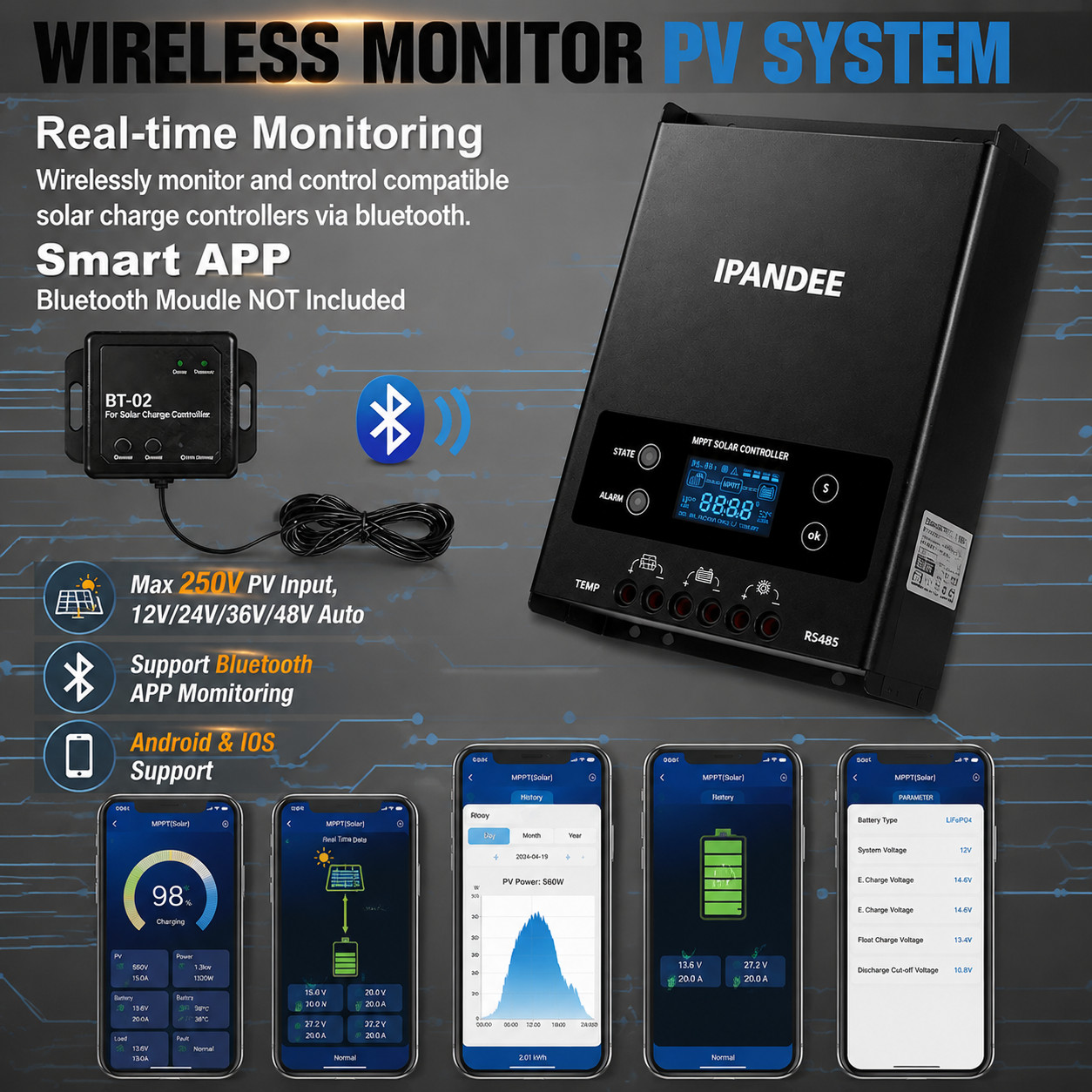
At USD 151.99, the lower-priced option is built around core charging: 100A continuous MPPT output for 12V, 24V, 36V, or 48V systems, up to 250V DC input, and 5200W of PV support. It pairs with lead-acid and lithium batteries, including LiFePO4, AGM, Gel, and flooded cells. If your solar bank needs reliable regulation without communication extras, this keeps the upfront cost closer to the bottom of the price range. The trade-off is that its feature set stays focused on charging; shoppers who want mobile monitoring or load-control modes are better served by the other controller.
Final choice by use case
- Stick with the 5200W 100A MPPT Solar Charge Controller for a straightforward off-grid bank and a leaner upfront cost.
- Step up to the MPPT Solar Charge Controller 100 Amp when your setup relies on connectivity, remote visibility, or load scheduling.