Choosing a charge controller for your solar BOS can feel like a math problem: how many amps do you need, and what voltage is your battery bank? At one end you have a $6.99 10A PWM controller aimed at small 12V/24V setups; at the other, a $326 MPPT controller built for 12V to 48V systems. This is a head-to-head between those two very different charge controllers.
Quick verdict
If you only need to regulate a modest solar panel and keep a battery healthy, the PWM controller is the sensible pick. If you are running a larger off-grid array, need more charging current than that, or have a higher-voltage battery bank, the MPPT controller is the one to choose.
Comparison table
| 10A PWM 12V/24V | MPPT 12V/48V | |
|---|---|---|
| Price | $6.99 | $326.00 |
| Charging mode | PWM | MPPT |
| System voltage | 12V/24V | 12V/24V/36V/48V |
| Max output current | 10A | 100A |
| Built-in display | LCD | LCD |
| Notable extras | Dual USB | Optional Bluetooth monitoring |
| Typical applications | Home, industrial, commercial | Agriculture/farming, automotive, home/garden |
Where each controller wins
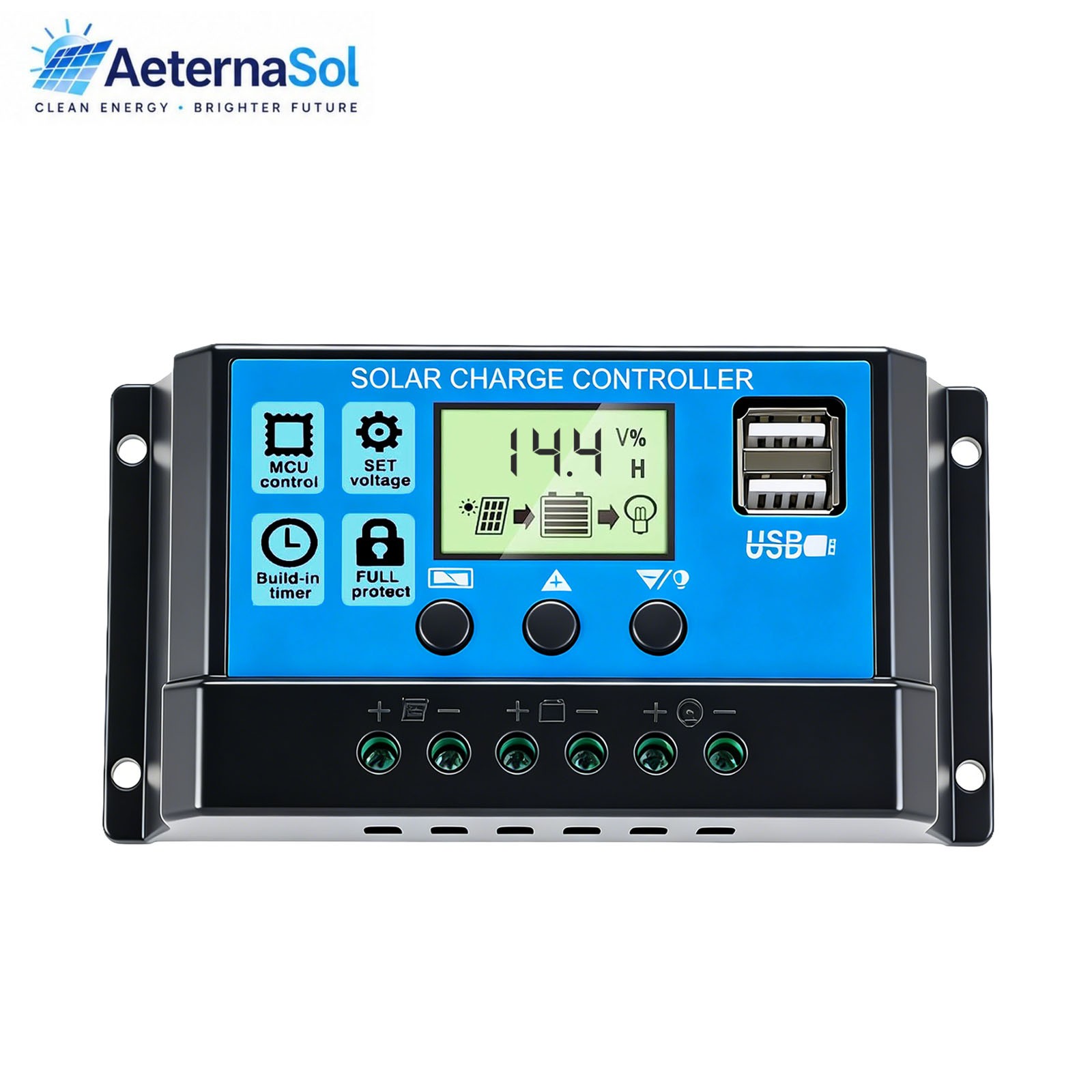
- The compact PWM controller wins for small battery maintenance and direct device charging. Its straightforward design suits a basic solar setup.
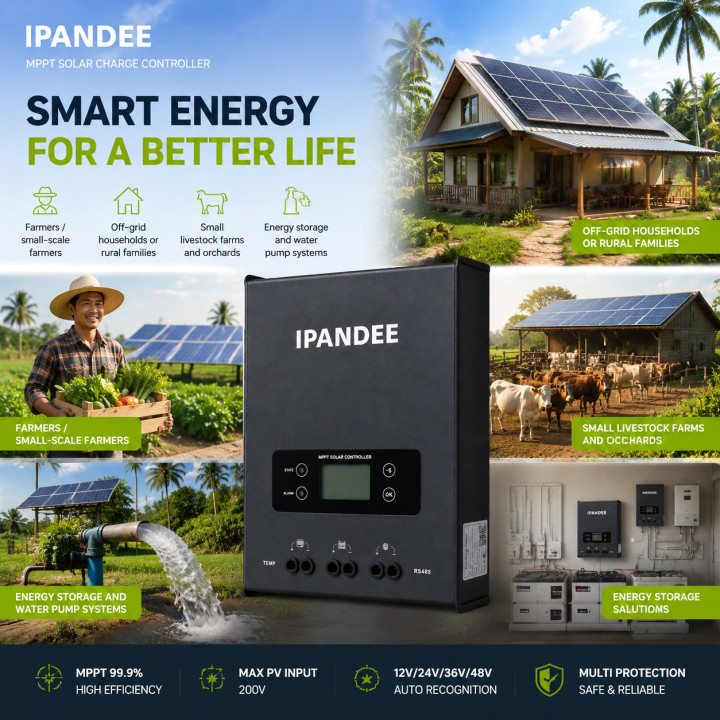
- The MPPT controller wins on charging capacity and system flexibility. It supports multiple battery chemistries and uses MPPT technology to capture more energy from the array.
10A PWM Charge Controller
This PWM controller keeps a smaller solar setup simple. Dual USB ports let you charge a phone or small device directly, and the unit includes short-circuit, reverse polarity, and overload protection. It also prevents battery power from flowing back to the panel at night, which helps avoid overnight drain. The clear limit is the 10A rating: this is not a controller for a large solar array or a higher-voltage battery bank. PWM charging also delivers less usable energy from excess panel voltage than an MPPT unit, so it is best paired with a modest panel and battery.
MPPT Solar Charge Controller
This MPPT controller is built for larger off-grid systems. It can deliver up to 100A of continuous charging current, and it supports multiple battery chemistries, including LiFePO4, AGM, Gel, and flooded lead-acid. An LCD and an optional Bluetooth module/SolarMate app let you keep an eye on charging data. The MPPT charging mode is designed to increase energy harvest from your solar array, so it fits systems where you want to maximize what your panels produce. The limitation is scale: this controller is more than a small single-panel setup needs, and the Bluetooth monitoring requires an optional module rather than being built in.
Final choice by use case
For a small battery with a modest panel, go with the PWM controller. For higher charging loads, a larger solar BOS setup, or systems where MPPT can improve energy yield, choose the MPPT controller.