Choosing a charge controller for a solar BOS setup is a two-part question: how much power will your panel array deliver, and what battery voltage do you need to charge? These two MPPT solar charge controllers answer that question very differently, with listed prices from $18.89 to $151.99. Let's look at what each one delivers before you commit.
Quick Verdict
If your solar BOS project runs on a 12V or 24V battery bank and you want a compact MPPT controller with a small listed price, the 30-100A MPPT Solar Panel Regulator Charge Controller is the straightforward pick. If you need a high-current regulator that can handle 12V, 24V, 36V, or 48V systems and a 5200W maximum rating, the 5200W 100A MPPT Solar Charge Controller is the more capable choice.
Listed Price and Feature Comparison
| Product | Listed Price | System Voltage | Battery Compatibility | Key Details |
|---|---|---|---|---|
| 30-100A MPPT Solar Panel Regulator Charge Controller | USD 18.89 | 12V / 24V | Lead-acid (OPEN, AGM, GEL) | Dual USB 5V/2.5A, LCD display |
| 5200W 100A MPPT Solar Charge Controller | USD 151.99 | 12V / 24V / 36V / 48V | Lead-acid & lithium (FLD, LiFePO4, SLD, Gel, AGM) | 100A output, 5200W rating, LCD display |
Where Each Product Wins
- The 30-100A MPPT Solar Panel Regulator Charge Controller wins on listed price and simple 12V/24V installations. The dual USB output gives you a convenient 5V/2.5A charging port for small devices.
- The 5200W 100A MPPT Solar Charge Controller wins on system flexibility and current capacity. It supports 36V and 48V battery banks and a broad range of battery chemistries, including LiFePO4, and carries a 100A continuous output rating.
Product Notes
#### 30-100A MPPT Solar Panel Regulator Charge Controller
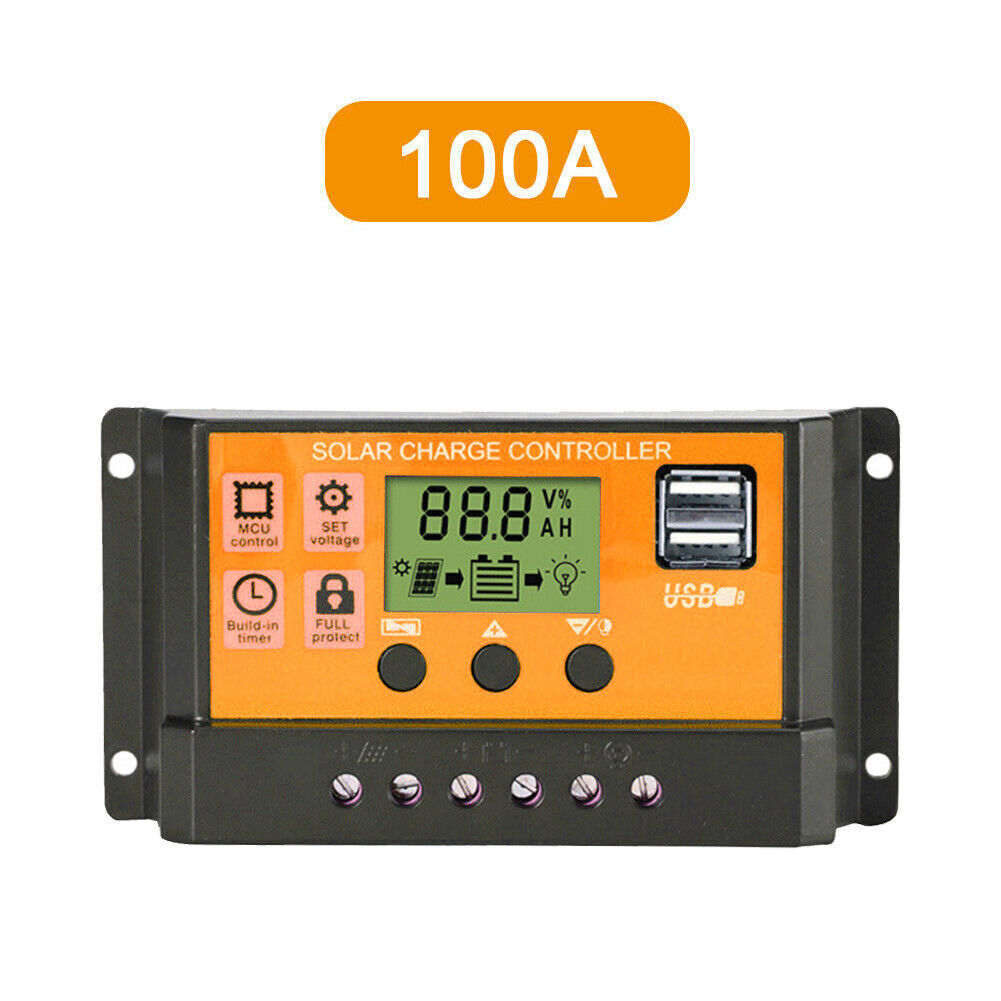
This blue 30-100A MPPT Solar Panel Regulator Charge Controller keeps things simple for a 12V or 24V battery bank. It includes dual USB outputs rated at 5V/2.5A, plus an LCD screen that shows charging status and lets you adjust parameters. It lists lead-acid battery compatibility with OPEN, AGM, and GEL types, and the auto-focus tracking name reflects operation across varying daylight conditions. For a home, industrial, or commercial setup where your panels feed a single low-voltage battery bank, this controller gives you MPPT charging without a big outlay. The trade-off is its voltage ceiling: it is listed for 12V/24V systems, so if your solar BOS build is centered on a higher-voltage battery bank, you will need the more powerful controller in this pairing.
#### 5200W 100A MPPT Solar Charge Controller
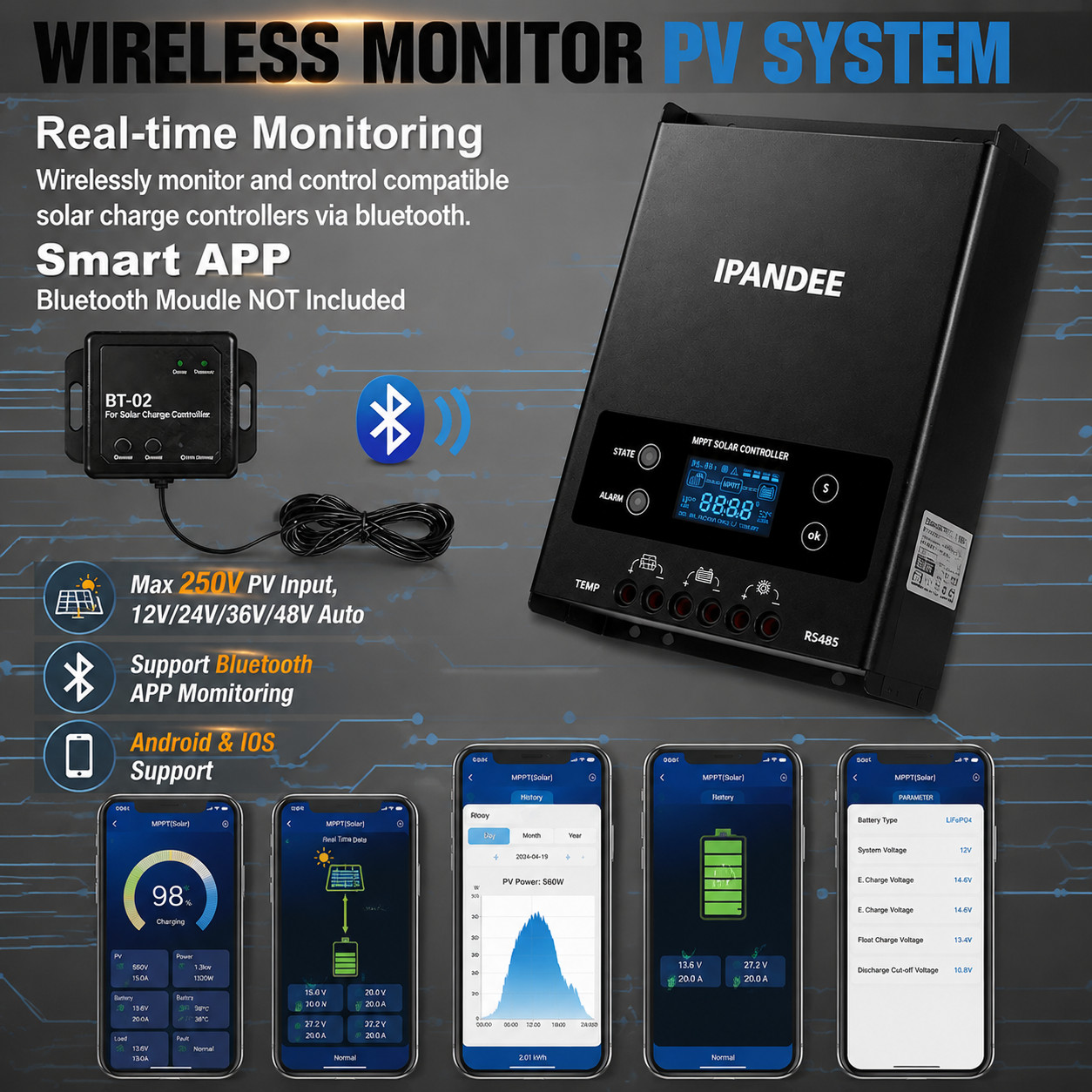
The 5200W 100A MPPT Solar Charge Controller is the higher-capacity side of this pairing. It supports 12V, 24V, 36V, and 48V battery banks, which makes it the flexible option for more demanding solar BOS layouts. It also lists compatibility with lead-acid and lithium batteries, including FLD, SLD, Gel, AGM, and LiFePO4, and its 100A current output is paired with a 5200W rating that suits agriculture, farming, automotive, home, and garden installations. With an LCD display and MPPT charging mode, it still offers the same monitoring convenience as the 12V/24V controller. What holds it back is the price: its listed price sits well above the other controller, so it makes sense mainly when your system actually needs the extra voltage and current capacity.
Final Choice by Use Case
Choose the 30-100A MPPT Solar Panel Regulator Charge Controller if you are outfitting a 12V or 24V lead-acid battery bank and want an MPPT regulator with LCD feedback and a low listed price. Choose the 5200W 100A MPPT Solar Charge Controller if your off-grid build runs on 36V/48V, uses lithium battery chemistries like LiFePO4, or needs the headroom of a 100A, 5200W-rated charge controller. For most compact home or workshop arrays at 12V/24V, the smaller controller is the easier fit; for larger solar BOS systems, the bigger controller earns its higher cost.