Choosing a solar charge controller usually comes down to matching the regulator to the current your panels can send and the voltage of your battery bank. In charge controllers solar BOS, two controllers often end up side by side: a 30A PWM regulator with an LCD and dual USB, and a 4800W 100A MPPT regulator that also adds USB and a backlit display. One keeps things simple for small systems; the other takes on heavier current and higher battery voltage.
Quick verdict
If your panels stay within 30A and your battery is 12V or 24V, the 30A PWM is the straightforward pick. If you need up to 100A of charging current or want 36V/48V support, the 100A MPPT is the better fit.
Price and feature comparison
| Controller | Listed price | Charging mode | System voltage | Current | USB |
|---|---|---|---|---|---|
| 30A Solar Panel Battery Charge Controller | USD 6.99 | PWM | 12V/24V | 30A | Dual USB |
| 4800W 100A MPPT Solar Charge Controller | USD 25.79 | MPPT | 12V/24V/36V/48V | 100A | USB |
Where each controller wins
The 30A PWM wins on simplicity and entry cost. It is built around 12V/24V work, and its dual USB ports make it convenient for charging small devices while protecting the battery with short-circuit, open-circuit, reverse, and over-load protections. The fully three-stage PWM charge management is designed to extend battery life.
The 100A MPPT wins on capacity and system-voltage range. With a 100A current rating paired with 4800W, it can manage much larger arrays. MPPT charging mode is the main difference in charging behavior, and support for 12V, 24V, 36V, and 48V means you can keep the same controller if you upgrade the battery bank.
Product notes
30A Solar Panel Battery Charge Controller 12V/24V LCD Regulator Auto Dual USB US
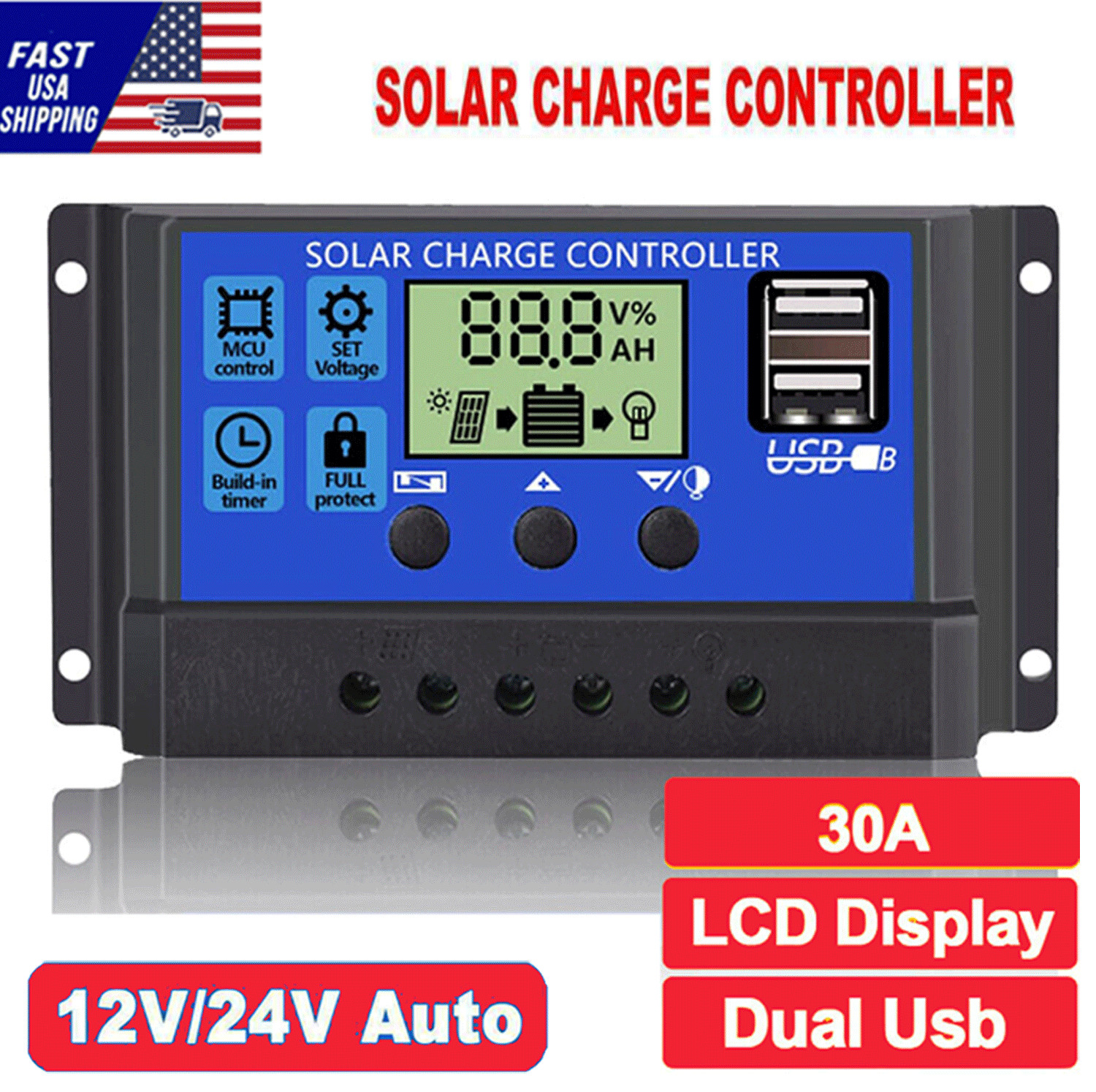
This PowMr regulator is the lower-cost entry point in this comparison, and the LCD plus auto dual USB ports make it easy to work into a small solar setup. Protections include short-circuit, open-circuit, reverse, and over-load protection, and the fully three-stage PWM charge management is aimed at keeping a 12V/24V battery healthy. It is suited to home, garden, and commercial solar setups, which matches its 30A rating. The limitation is the ceiling: 30A is the stated maximum current and 24V is the maximum nominal voltage. If your panels can produce more current or you move to a 36V/48V battery, this controller will run out of headroom. For a modest panel with a 12V or 24V bank, the listed price keeps the entry barrier low.
4800W 100A MPPT Solar Charge Controller USB 12V 24V 36V 48V PV Battery Regulator
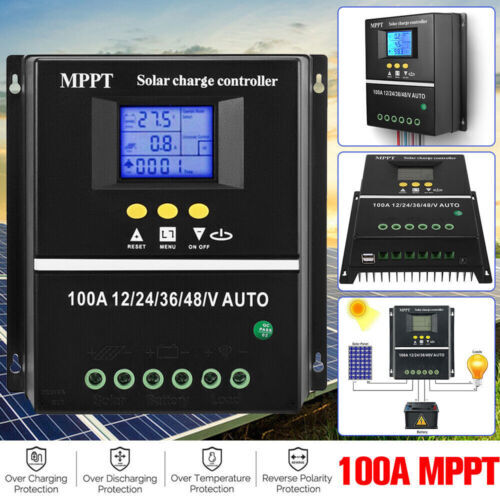
This controller puts the emphasis on capacity. The 4800W/100A pairing in the title is aimed at larger PV arrays, and the MPPT charging mode is the capability that sets it apart from a PWM regulator. It handles 12V, 24V, 36V, and 48V systems, so there is room to grow. The backlit LCD and one-key panel controls adjust float charging voltage, boost charging voltage, light control, and time delay, which gives you more ways to tune the charge profile. The trade-off is that it is the higher-listed-price option in this comparison. If your array stays under 30A and your battery stays at 12V or 24V, the extra current capacity and voltage range are more than you need. The USB port is a convenience, not the main reason to pick this unit.
Final choice by use case
Pick the 30A PWM controller when your panels stay within 30A, your battery is 12V or 24V, and you want the USD 6.99 listed price. Pick the 4800W 100A MPPT controller when you run a 36V/48V bank or expect charging current up to 100A; the USD 25.79 list price buys the larger headroom.