When you're putting together a solar power setup, the charge controller is a key part of the solar BOS - the balance-of-system components that make the panels and battery work together safely. Both of these controllers do that job, but they're aimed at very different systems. The PowMr 30A PWM is a PWM regulator; the IPANDEE 60A MPPT brings maximum power point tracking and support for higher battery voltages. Which one makes sense depends on the size of your battery bank, the voltage of your panels, and how much energy you hope to capture.
Quick Verdict
If you have a small battery bank and don't need to squeeze every possible watt out of your panels, the PowMr 30A PWM is a straightforward regulator for a simpler system. If your battery bank is larger, your panel array needs more headroom, or your installation is in a marine or shed environment, the IPANDEE 60A MPPT is the more capable choice.
At a Glance
| Product | Price | Price Indicator | Charging Type | Battery Voltage |
|---|---|---|---|---|
| PowMr 30A PWM Charge Controller | $6.99 | PWM | 12V/24V | |
| IPANDEE 60A MPPT Charge Controller | $129.99 | MPPT | 12V/24/36/48V |
The price gap between these two is large, but so is the difference in what they can do. The PWM model is a simpler controller for smaller systems; the MPPT model accepts a 200VDC PV input and up to 3120W of input power.
Where Each Product Stands Out
- The PowMr 30A PWM is the practical pick for a smaller home or garden setup. It has an LCD display, dual USB ports, and protection against short circuits, open circuits, reverse polarity, and overloads.
- The IPANDEE 60A MPPT is built for higher-demand setups. It has a metal housing, LCD and LED indicators, and a multi-curve MPPT algorithm that keeps tracking the maximum power point as sunlight changes.
Product Notes
30A Solar Panel Battery Charge Controller 12V/24V LCD Regulator Auto Dual USB US
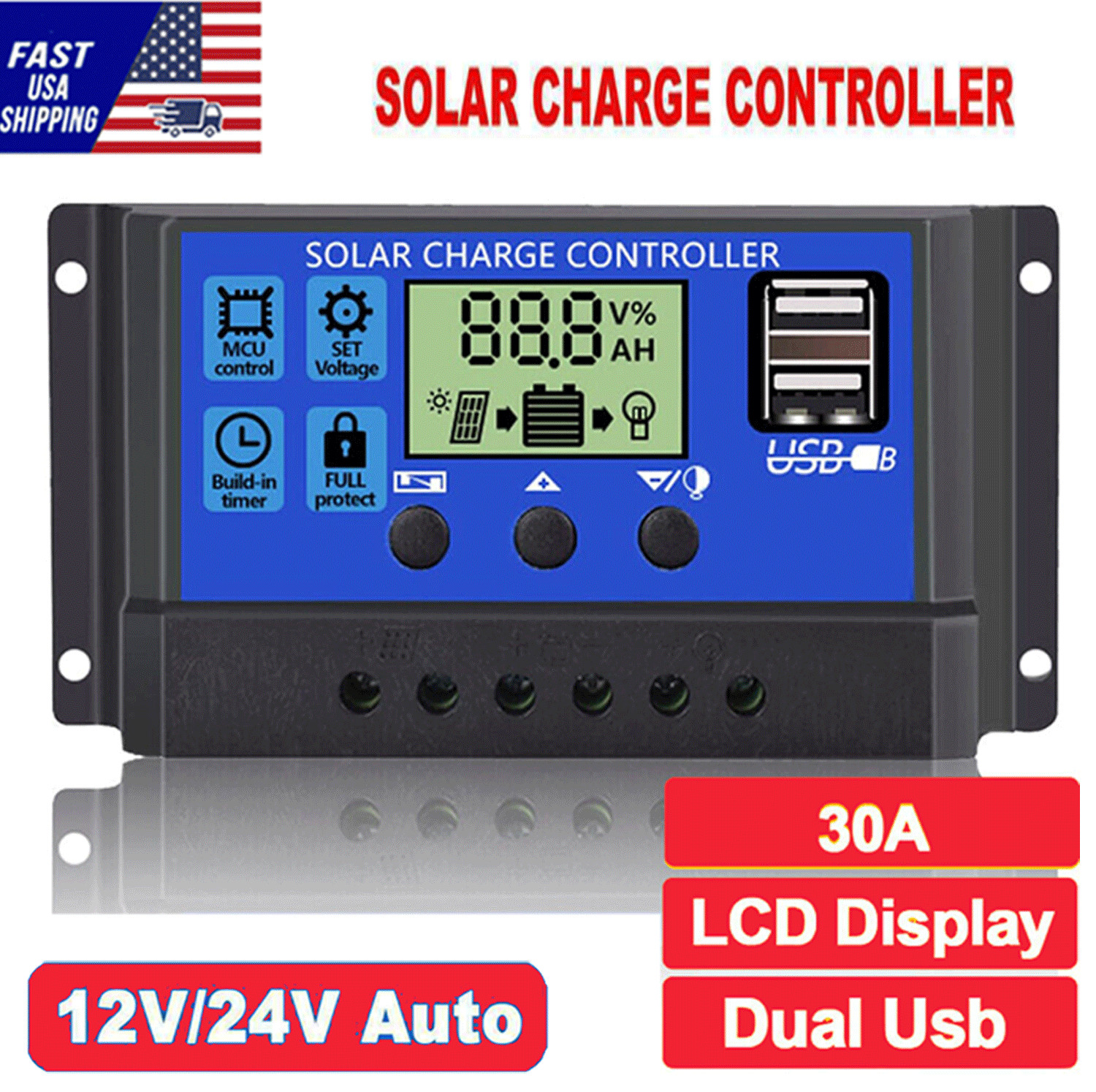
With a 30A current rating and support for 12V/24V batteries, this PWM controller is built around an industrial micro controller and uses three-stage PWM charging to manage power flow. The LCD display shows system status and lets you adjust parameters, while the dual USB ports give you a convenient output for small devices. It also includes short-circuit, open-circuit, reverse, and overload protection, which is useful for a home or garden installation. This controller makes sense when your solar panel battery system stays within 12V/24V and 30A, and when you don't need high-voltage MPPT tracking. The trade-off is that PWM doesn't capture the extra energy that MPPT can, and the voltage window is limited to 12V/24V.
60A MPPT Solar Charge Controller for 12V/24/36/48V Battery Regulator Max.PV 200V

The IPANDEE 60A MPPT is a more advanced controller for home, garden, marine, or shed installations. It supports 12V/24/36/48V batteries and accepts a maximum PV input of 200VDC with a maximum input power of 3120W. The multi-curve MPPT algorithm is designed to keep tracking the true maximum power point as sunlight changes, and the reinforced power design helps maintain output in demanding conditions. An LCD display and LED indicators make status easy to read, and the metal housing adds durability. This is the one to choose when your panel voltage and battery bank require more than a PWM controller can channel, and when you want to pull more usable energy from the same panels. The limitation is the higher price: for a small 12V array, the extra cost may not be justified.
Final Choice by Use Case
Choose the PowMr 30A PWM when you're setting up a compact home or garden battery bank and you want a straightforward regulator. Choose the IPANDEE 60A MPPT when your battery bank runs at higher voltages, your solar panels are wired to a higher PV voltage, or you need a controller suited to a marine or shed environment. For bigger, higher-voltage builds, the MPPT version is the one that can keep up; for simple, small solar battery systems, the PWM version is the more sensible start.