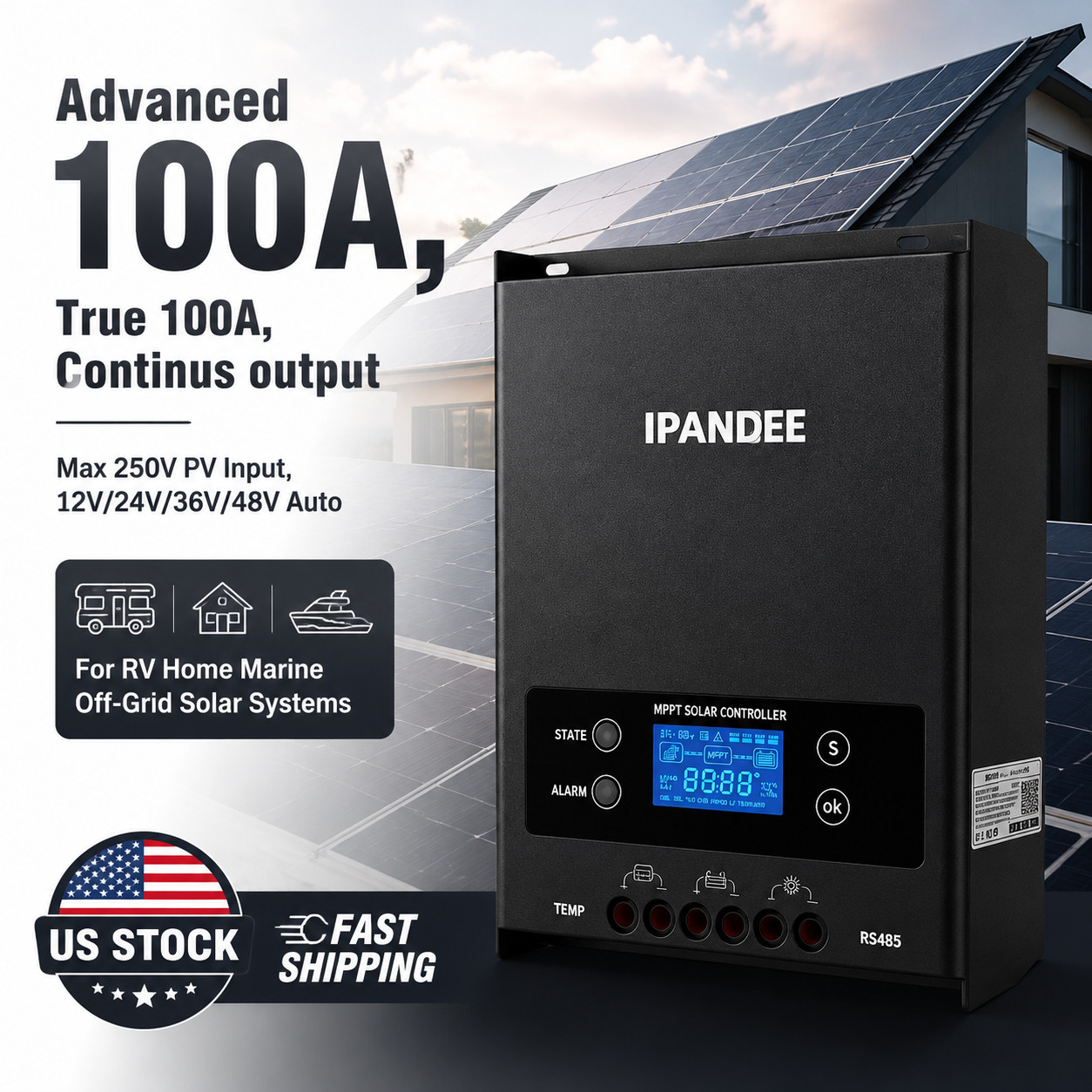
Choosing a solar charge controller for an off-grid power system usually means balancing current capacity, input voltage, and price. These two IPANDEE 100A MPPT controllers both work with 12V/24V/36V/48V lead-acid and lithium battery banks, and both accept the same broad list of battery chemistries: FLD, LiFePO4, SLD, Gel, AGM, and others. The problem is that one costs USD 153.99 while the other costs USD 326.00. So what does the extra USD 172.01 buy you, and which one should you actually install?
Quick verdict
If you want the lowest price for 100A MPPT charging and your solar array can take advantage of high input voltage, the 5200W 250V 100A MPPT Solar Charge Controller is the straightforward choice. If you need remote monitoring, RS485 Modbus communication, and extra load modes, spend more on the 100A Auto MPPT Solar Charge Controller. Both handle the same battery types, so the decision comes down to whether smart monitoring is worth the extra cost.
At a glance
| Feature | 5200W 250V 100A MPPT | 100A Auto MPPT Solar Controller |
|---|---|---|
| Price | USD 153.99 | USD 326.00 |
| Battery systems | 12V/24V/36V/48V | 12V/24V/36V/48V |
| Battery types | Lead-Acid & Lithium (FLD, LiFePO4, SLD, Gel, AGM, etc.) | Lead-Acid & Lithium (FLD, LiFePO4, SLD, Gel, AGM, etc.) |
| Stated rating | 5200W, 250V DC | 100A continuous |
| Standout feature | High input voltage/power at lower price | APP monitoring, RS485 Modbus, 5 load modes |
Where each controller wins
5200W 250V 100A MPPT: It is the lower-priced option by a wide margin. At USD 153.99, it costs USD 172.01 less than the other controller. The 5200W and 250V rating in the product name makes it an obvious candidate for higher-voltage solar arrays, while still offering the same 100A output and battery chemistry compatibility.
100A Auto MPPT Solar Controller: It is the feature leader. The product name says 100A Auto, and the description highlights APP monitoring via an optional Bluetooth module and SolarMate app, plus RS485 Modbus communication, five load modes, and lithium activation. If you want to see charging status and battery data without walking to the controller, this is the one to buy.
IPANDEE 100A Auto MPPT Solar Charge Controller
The more expensive IPANDEE controller, listed at USD 326.00, makes remote monitoring a practical reality. It connects with an optional Bluetooth module and SolarMate app, which means you can check charging status, battery data, and system performance from your phone. It also includes RS485 Modbus communication for integration with existing monitoring setups, five load modes for flexible load management, and lithium activation for LiFePO4 and similar batteries. The LCD display gives you on-device readings as a fallback. The downside is the price: it is USD 172.01 more than the other IPANDEE, and the product name does not state a specific solar input wattage or voltage ceiling. If your panels are arranged in a way that needs high input voltage, you may find yourself looking at the other model instead.
5200W 250V 100A MPPT Solar Charge Controller
This controller, at USD 153.99, is the obvious choice for budget-conscious off-grid builders who want maximum solar power per dollar. The product name spells out 5200W and 250V DC input, which helps when you're designing a series-string array that reduces current and lets you use thinner wire. It still provides a true 100A continuous output and supports 12V/24V/36V/48V systems with the same lead-acid and lithium battery compatibility as the pricier model. The trade-off is that it doesn't list app-based monitoring or RS485 communication, so phone-based visibility is not part of its pitch. You get an LCD display and the standard protections, but for remote monitoring you'd need to add your own solution. With the money saved, you could upgrade other parts of the system.
Final choice by use case
Pick the 5200W 250V 100A MPPT if you're fitting a new array with high-string voltage and you want to keep the cost of the charge controller as low as possible. Pick the 100A Auto MPPT if you plan to monitor your system remotely, need RS485 Modbus integration, or want extra load management options. Battery chemistry won't separate them, because both handle lead-acid and lithium banks. The real question is whether USD 172.01 of built-in monitoring and communication is worth spending.