Choosing a solar charge controller for a balance-of-system setup usually comes down to two questions: will it handle your battery bank, and how much do you need to spend? Both of these MPPT controllers cover the standard 12V/24V/36V/48V range, but their prices sit at opposite ends of the scale. That gap sets up a clear decision: pay for extra capabilities or keep the build cost down.
Quick Verdict
The IPANDEE costs USD 326.00 and offers the more complete feature set. The 4800W costs USD 25.79 and is the low-cost pick. Both are MPPT controllers for 12V, 24V, 36V, and 48V systems. If you only need basic MPPT charging and want to spend as little as possible, the lower-priced controller is likely enough. If you plan to expand your system, the higher-priced unit gives you room to grow.
Comparison Table
| Product | Price | Price Bar | Current Rating |
|---|---|---|---|
| IPANDEE MPPT 100A | USD 326.00 | 100A | |
| 4800W MPPT USB 100A | USD 25.79 | 91-100 A |
Where Each Product Wins
The IPANDEE wins for battery chemistry support and system integration. Its compatibility spans flooded, gel, AGM, SLA, LiFePO4, and lithium-ion chemistries, and the optional Bluetooth module adds remote monitoring.
The 4800W wins for its user-adjustable operating modes. Seven modes, including light control and manual control, make it adaptable without extra accessories.
Product Notes
IPANDEE MPPT Solar Charge Controller 100 Amp 12V 24V 36V 48V Auto Solar Panel Controller
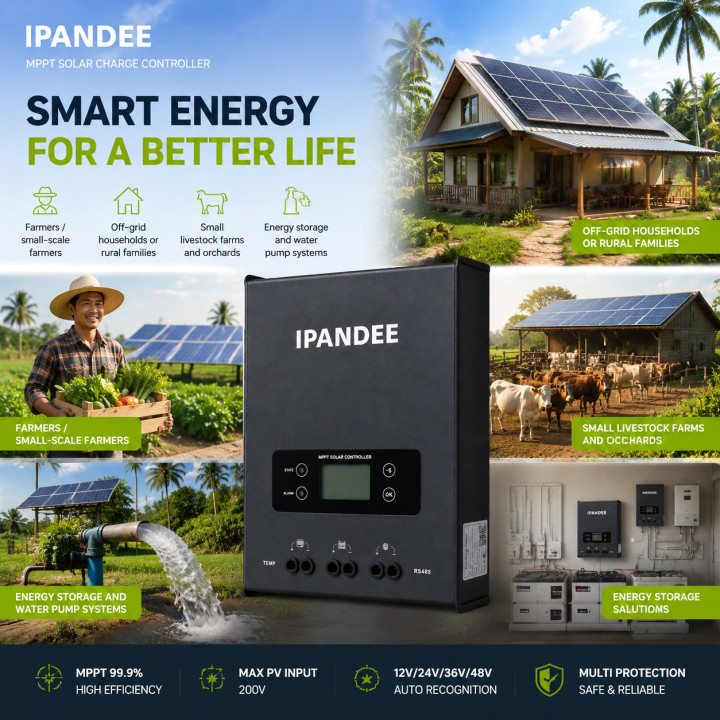
The IPANDEE controller is the better fit when battery chemistry and data matter. Its compatibility list covers flooded, gel, AGM, SLA, LiFePO4, and lithium-ion batteries, with lithium activation support, which is useful if you are moving from lead-acid to lithium. The LCD shows charging status, and the five load modes give you flexibility for different output profiles. You can also pair it with an optional Bluetooth module to watch charging status and battery data through the SolarMate app, and the RS485 Modbus port gives you a way to connect to a monitoring system. The built-in protections include reverse polarity, overload, short circuit, overcharge, and over-temperature. The main limitation is the price: it asks for a noticeably larger investment than the other MPPT controller here, so it makes sense when you need those extra capabilities rather than just a basic regulator.
4800W 100A MPPT Solar Charge Controller USB 12V 24V 36V 48V PV Battery Regulator
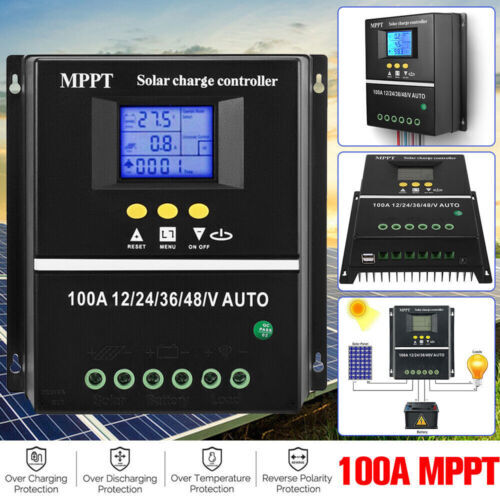
If you are putting together a simple solar setup without a lot of extra hardware, the 4800W controller gives you the essentials. The USB port is a practical addition, and the LCD backlit display lets you adjust float voltage, boost voltage, light control, and delay settings with the panel keys. The front-panel keys give you one-key operation for adjusting system control parameters. Seven operating modes cover charging, light control, combined light-and-time control, universal control, manual control, timing control, and factory test mode, so you can tailor the controller to a basic off-grid or lighting job. If you need to change behavior quickly, the mode selection makes that straightforward. The limitation is in the specification: the current rating is listed as 91-100 A rather than a fixed 100A, so it is a 100A-class controller rather than one with a clearly documented continuous rating.
Final Choice by Use Case
If you are building a permanent home, farm, or vehicle power solution and want the more complete package, the IPANDEE is the safer long-term choice. If you need a working MPPT controller for a quick setup, the 4800W unit is the best pick.