Picking a solar charge controller for your balance-of-system comes down to matching the controller to your battery bank, not just picking a familiar name. This head-to-head puts the IPANDEE 100A MPPT Solar Charge Controller against The Perfect Part 30-100A MPPT Solar Panel Regulator. Both use Maximum Power Point Tracking, both include an LCD display, and both are new. The decision is about voltage range, battery chemistry, current capacity, and the features you need.
Quick verdict
Choose the IPANDEE 100A MPPT if you need a high-capacity controller with the flexibility to handle a larger battery bank. Choose The Perfect Part 30-100A MPPT if you want a low-priced MPPT regulator with selectable current levels and dual USB output. The price gap is roughly $307, so your battery bank size and chemistry should drive the decision.
Comparison at a glance
| Feature | IPANDEE 100A MPPT Controller | The Perfect Part 30-100A MPPT Regulator |
| Price | USD 326.00 | USD 18.89 |
| Price position | | |
| MPPT tracking | Yes | Yes |
| Supported system voltage | 12V, 24V, 36V, 48V auto | 12V and 24V |
| Current levels | 100A continuous | 30A, 60A, or 100A selectable |
| Battery types | Lead-acid and lithium: FLD, LiFePO4, SLD, Gel, AGM | Lead-acid: OPEN, AGM, GEL |
| Display | LCD | LCD |
| Applications | Agriculture/Farming, Automotive, Home/Garden | Home, Industrial, Commercial |
Where each controller wins
IPANDEE 100A MPPT wins on flexibility and protection. It supports more battery chemistries and adds safeguards against reverse polarity, overload, short circuit, overcharge, and over-temperature.
The Perfect Part 30-100A MPPT wins on simplicity and convenience. It includes a dual USB output for charging small devices at 5V/2.5A and uses an industrial microcontroller to remember parameter settings.
Product notes
IPANDEE 100A MPPT Solar Charge Controller

The IPANDEE controller is built for installations that need more from a solar charge controller. It delivers 100A continuous charging and supports lead-acid plus lithium battery types, including LiFePO4, AGM, Gel, and flooded batteries. Five load modes and RS485 Modbus communication make it a flexible system component, and protection against reverse polarity, overload, short circuit, overcharge, and over-temperature covers the main ways a solar setup can fail. The tradeoff is that app monitoring is not built in; you need the optional Bluetooth module to use the SolarMate app. That makes this controller a strong choice for someone who wants system-level visibility and has a battery bank large enough to use the full 100A capacity.
The Perfect Part 30-100A MPPT Solar Panel Regulator
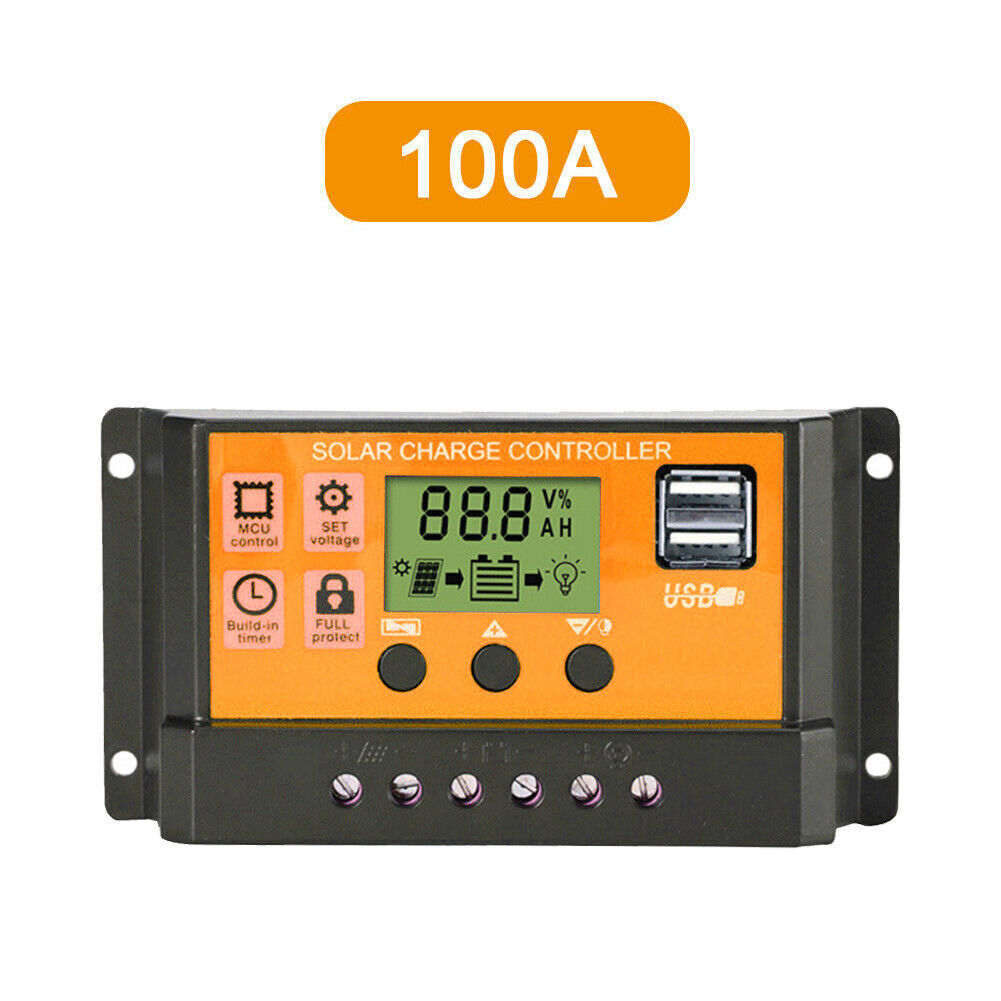
The Perfect Part controller is the more approachable pick in this pairing. It supports 30A, 60A, or 100A current levels and includes a dual USB output for charging small devices at 5V/2.5A. Its industrial microcontroller remembers parameter settings even when the battery runs out, and the interface makes mode switching and parameter configuration simple. The main limitation is voltage range: this is a 12V/24V controller, so it won't match a 36V or 48V battery bank. For a basic lead-acid setup, it gives you the essentials without the complexity of a larger system controller.
Final choice by use case
- If you need a high-capacity controller for a large off-grid system, the IPANDEE 100A MPPT controller is the one to build around.
- If you need a straightforward lead-acid controller, The Perfect Part 30-100A MPPT regulator covers the essentials.
- If the controller feeds a smaller home, industrial, or commercial setup, The Perfect Part is the practical pick.