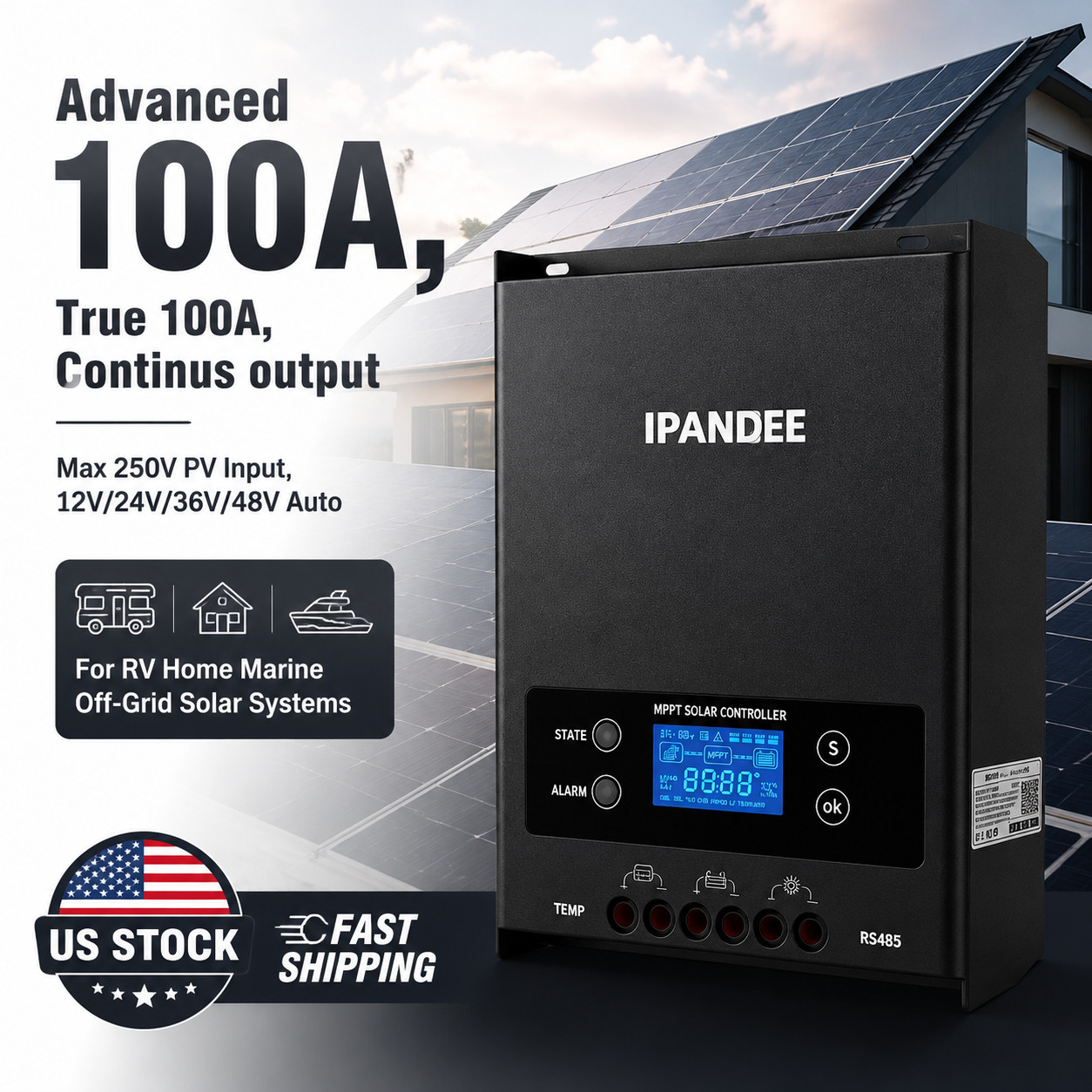
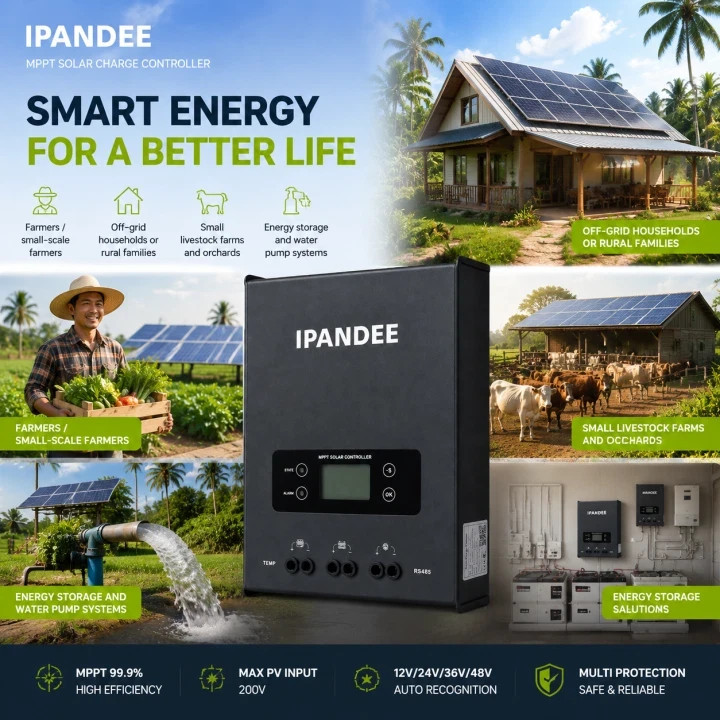
When you're building a 12V/24/36/48V solar system, the charge controller is the part that decides how much of your panel's power actually gets stored. IPANDEE offers two MPPT options that look similar on the surface: a 100A controller rated for up to 5200W and 250V PV input, and a 60A controller for arrays up to 3120W and 200V input. The 60A is priced at $129.99, about 16% below the 100A's $153.99. So the real question is whether you need the extra headroom or whether the 60A rating is enough.
Quick Verdict
If you plan to grow your solar array, have panels wired above 200V, or need more than 60A of charging current, choose the 100A IPANDEE controller. If your array fits within 60A/3120W/200V, the 60A controller is a capable alternative.
At a Glance
| Decision point | 5200W 250V 100A controller | 60A MPPT controller |
|---|---|---|
| Listed price | $153.99 | $129.99 |
| System voltage | 12V/24/36/48V | 12V/24/36/48V |
| Nominal charge current | 100A | 60A |
| Max PV input | 250V | 200V |
| Max input power | 5200W | 3120W |
| MPPT | Multi-curve MPPT | Multi-curve MPPT |
| Display | LCD | LCD with LED indicator |
| Uses | Agriculture/Farming, Automotive, Home/Garden | Home/Garden, Marine, Shed |
Where Each Controller Wins
The 100A controller wins for larger solar systems. Its 100A output, 250V PV input limit, and 5200W rating give it room to handle a bigger panel array without needing a second controller. It also covers agriculture/farming and automotive use, adding flexibility for workshop, barn, or RV builds.
The 60A controller wins for smaller installations. It still uses the same multi-curve MPPT algorithm, but at 60A and 3120W it's matched to more compact arrays. It's designed for home/garden, marine, and shed use, making it a natural fit for boating or outbuilding systems.
5200W 250V 100A MPPT Solar Charge Controller
This is the controller to choose when you'd rather not think about upgrading later. The 100A charging current is the biggest advantage: if your battery bank can accept it, you can replenish a depleted bank faster than a 60A unit on the same panels. With a 250V PV input limit and 5200W max input power, it can take a larger solar array, which is a genuine benefit for a 12V/24/36/48V system where panel voltage can climb quickly. The IPANDEE controller uses an advanced multi-curve MPPT algorithm with up to 99.9% tracking efficiency and over 98% conversion efficiency, and it's designed for true 100A continuous output. It's aimed at agriculture/farming, automotive, and home/garden installations, so it's a flexible choice for many setups. The limitation is capacity overshoot: if your array stays small, you won't need this much headroom.
60A MPPT Solar Charge Controller for 12V/24/36/48V Battery Regulator Max.PV 200V
This 60A controller is aimed at smaller arrays, and it still shares the core MPPT strengths of the IPANDEE line. For a 12V/24/36/48V system, it offers 60A continuous output, a 200V PV input limit, and 3120W max input power. That's enough for many home/garden setups, and the intended uses include marine and shed installations, so it suits spaces where power needs are modest. It also pairs an LCD display with an LED indicator, making charging status easy to check. The main limitation is the ceiling: at 60A and 200V max PV input, this controller won't handle a larger or higher-voltage array. If you later add more panels or rewire with a higher-voltage string, you'd need to move up to the 100A unit. For a system that's already defined, this is a solid fit.
Final Choice by Use Case
Choose the 100A IPANDEE controller if you have or plan to build a larger solar array, if your PV string can exceed 200V, or if you want the extra charging capacity to shorten charge times on a big battery bank. Choose the 60A IPANDEE controller if your array fits within 3120W and 200V, if your daily charging needs stay at or below 60A, and if future expansion isn't on the horizon.