When you're choosing a solar charge controller for an off-grid solar system, the tension is the same: pay for more charging capacity than you need, or save money and risk running out of headroom. IPANDEE's two MPPT controllers cover both ends of that trade-off. The smaller 40A unit is the lighter-duty option; the larger 100A unit brings more output and voltage flexibility. The right pick depends on your battery bank, panel output, and how much room you want to grow.
Quick Verdict
If your solar array is modest and you're using a common lower-voltage battery bank, the IPANDEE 40A MPPT Solar Charge Controller is the pragmatic buy. If your system needs more power and voltage flexibility, the IPANDEE 5200W 250V 100A MPPT Solar Charge Controller is the one to step up to.
Side-by-Side Comparison
| Feature | IPANDEE 40A MPPT | IPANDEE 5200W 100A MPPT |
|---|---|---|
| Price | USD 105.99 | USD 153.99 |
| Output current | 40A | 100A |
| System voltage | 12V / 24V | 12V / 24V / 36V / 48V |
| Display | HD OLED | LCD |
| Battery compatibility | Lead-acid / lithium | Lead-acid / lithium (FLD, LiFePO4, SLD, Gel, AGM) |
| Typical placement | Agriculture, automotive, home/garden | Agriculture, automotive, home/garden |
Where Each Product Wins
The smaller controller wins on:
- Industrial-grade aluminum housing
- A claimed 6-year design life
- Full output without relying on cooling fans
The bigger controller wins on:
- Higher output for larger battery banks and bigger loads
- Support for a wider range of battery voltages
- Higher claimed tracking and conversion efficiency: up to 99.9% tracking and over 98% conversion
- Reinforced 1.5X power design to keep output steady under load
Product Notes
MPPT 40A Solar Charge Controller 12V 24V Regulator For Lead-Acid/Lithium Battery
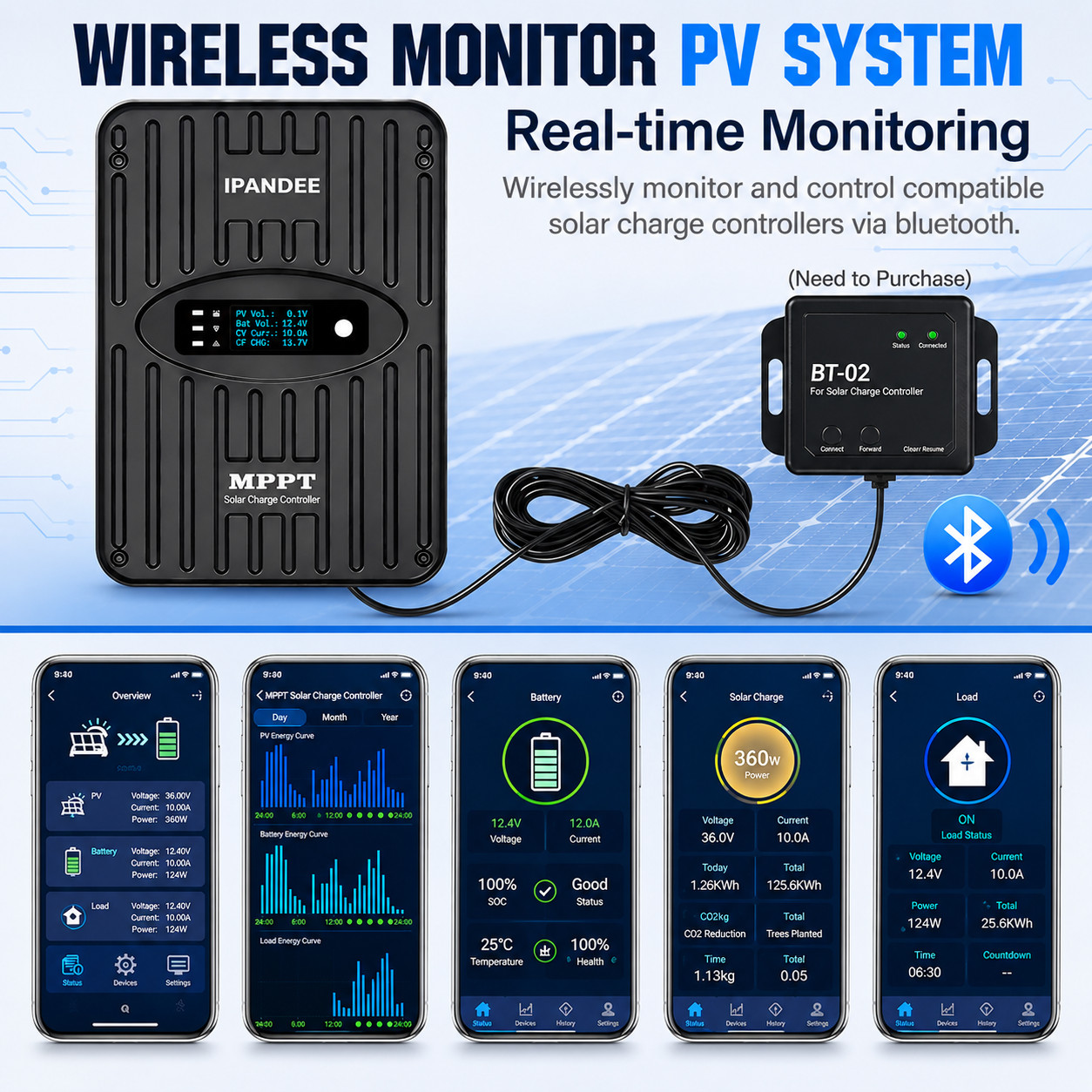
This is the smaller, more focused option. It's built for 12V and 24V battery banks and delivers a continuous 40A DC output, which covers many smaller home, garden, automotive, and agricultural setups. The HD OLED display and industrial-grade aluminum housing make it easy to check charging status at a glance. IPANDEE says its multi-curve MPPT technology can harvest up to 35% more energy than conventional controllers, so cloudy or low-light conditions don't waste as much of your panel's output. The main limitation is its ceiling: it doesn't support the higher battery voltages the larger model handles, and 40A will cap you if you later expand your solar array.
5200W 250V 100A MPPT Solar Charge Controller 12V/24/36/48V LCD Battery Regulator
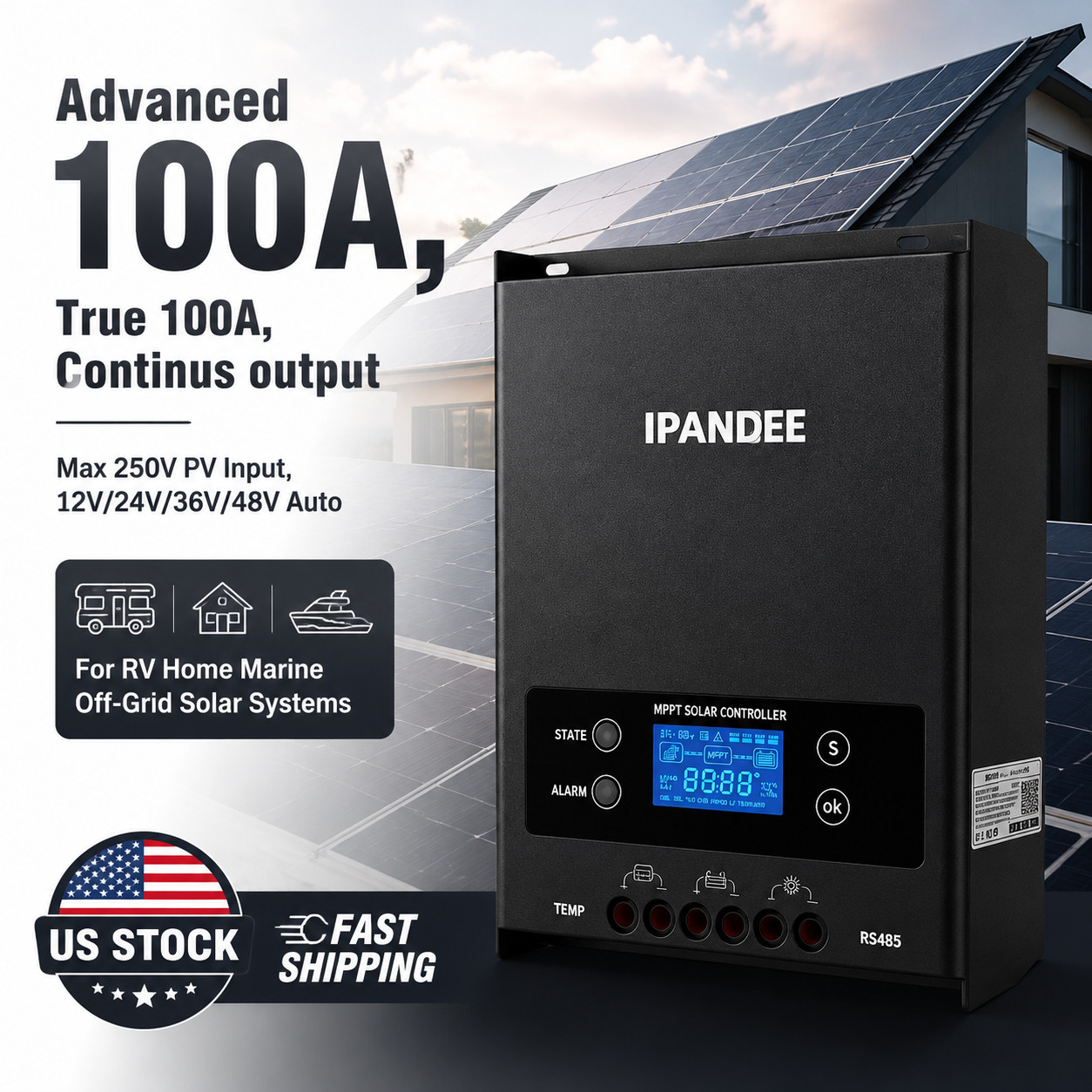
This is the larger, higher-output option. It's rated for 100A of output and supports a wider voltage range, making it a better fit for larger off-grid arrays, workshop power, or systems you plan to expand. IPANDEE quotes up to 99.9% tracking efficiency and over 98% conversion efficiency, plus a reinforced 1.5X power design to maintain output under heavy loads. The LCD display is clear, though it lacks the HD OLED display of the smaller unit. The real downside is that all that output and voltage support is overkill for a small setup; you won't tap into the 100A or 5200W unless your system grows.
Final Choice by Use Case
Choose the MPPT 40A IPANDEE controller if you have a modest battery bank and a smaller solar array, and you want to keep the upfront cost at $105.99.
Choose the 5200W 250V 100A IPANDEE controller if you're running a bigger array, need more charging muscle, or want the 250V/5200W overhead for future expansion at $153.99.