Choosing a solar charge controller often comes down to two questions: how much battery current do you need, and how much control do you want over the charging profile? For an off-grid solar build, the Renogy Rover Lite MPPT and the 4800W MPPT represent two different answers at two very different price points.
Quick verdict: The Renogy Rover Lite MPPT is the controller to pick when defined charging profiles, monitoring, and cold-weather operation are your priorities. The 4800W MPPT is the lower-price option, offering manual adjustment. If you want a defined, set-and-forget charge profile and can budget $179.99, the Renogy is the stronger all-rounder. If $25.79 fits your build and you're comfortable configuring parameters yourself, the 4800W controller is worth a close look.
| Comparison | Renogy Rover Lite 60A | 4800W 100A MPPT |
|---|---|---|
| Listed price | $179.99 | $25.79 |
| Charging type | MPPT | MPPT |
| Listed current | 60A | 100A |
| System voltages | 12V/24V/36V/48V | 12V/24V/36V/48V |
| Battery presets | AGM, Gel, Flooded, LiFePO4, User Custom | Adjustable via LCD panel |
| Extra controls | RS485 communication | Backlit LCD, seven operating modes |
Where each product wins
Renogy Rover Lite MPPT wins where a clean installation and defined battery chemistry matter. The six-panel series wiring option can reduce cable runs, and the MPPT conversion is rated above 97%. Low-temperature protection adds confidence for year-round use.
The 4800W MPPT wins on raw charging current and upfront cost. Its operating modes give you flexibility for non-standard systems.
Product notes
Renogy Rover Lite 60A MPPT
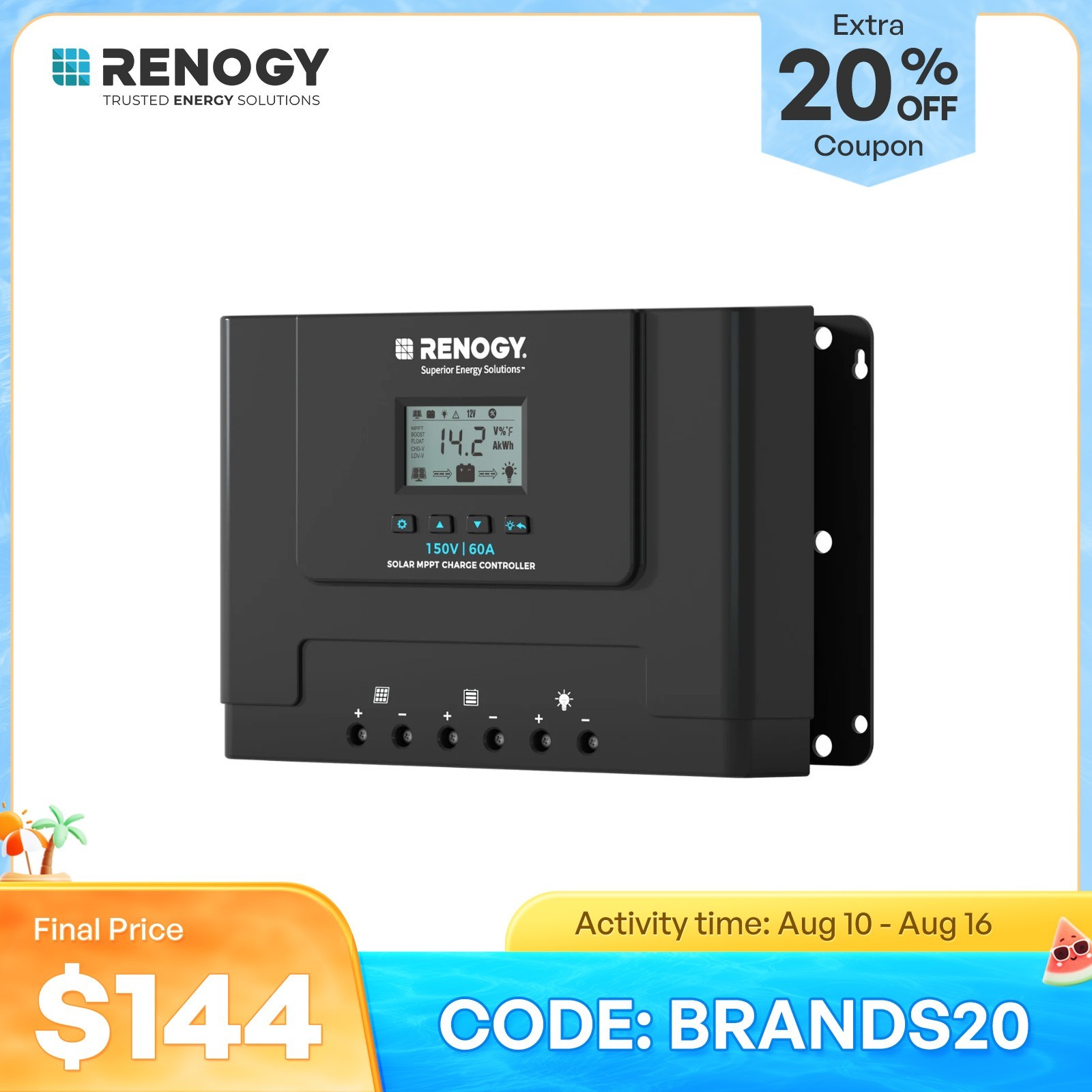
The Renogy Rover Lite 60A is built around defined charging profiles, which makes it a strong fit if you want the controller to handle battery chemistry for you. The preset options cover AGM, Gel, Flooded, Lithium-iron Phosphate, and a User Custom profile, so you can move between battery types without starting over. The >97% conversion efficiency means less energy lost in the charging process, and the RS485 communication port gives you a way to check system data. The six-panel series wiring option is a practical plus for reducing cable runs on larger arrays. The main limitation is the 60A output ceiling: if your battery bank demands more charging current, you will outgrow this controller. It also sits at the higher end of the price range for this comparison, so it is better suited to a permanent solar setup than a stopgap build.
4800W 100A MPPT Solar Charge Controller
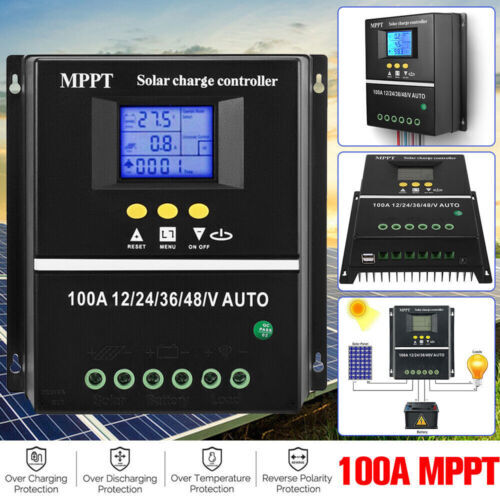
The 4800W 100A MPPT puts the control in your hands with a backlit LCD display and one-key operation. The panel lets you adjust float voltage, boost voltage, light-control timing, and other parameters, and the seven operating modes include charging, light control, light-and-time delay, universal, manual, timing, and test. That kind of flexibility is useful for custom setups where a fixed battery preset isn't what you need. The 100A current output is the main reason to choose it: it gives you far more charging headroom for a battery bank that needs more current. The flip side is that the feature set focuses on manual LCD adjustment rather than predefined battery chemistry presets or a communication port, so you'll set the charge voltages yourself. If you're comfortable doing that, this controller delivers a lot of current for a small outlay.
Final choice by use case
Choose the Renogy Rover Lite MPPT if you want preset battery chemistry profiles, cold-weather protections, and a controller that handles the battery type for you, and if your off-grid system can work within its charging path. It is the better fit for a permanent RV, cabin, or backup power setup where battery longevity is the priority. Choose the 4800W MPPT if you need maximum charging current at the lowest listed price and prefer to manage charge parameters through the LCD controls. For a large battery bank, a temporary build, or a project where manual configuration is part of the plan, the 4800W controller is the practical pick.