Choosing a charge controller for your solar balance-of-system setup is usually a matching exercise: your array's voltage and current have to stay inside the controller's limits, and the battery profiles have to match the bank. The Renogy Rover Lite 60A MPPT solar charge controller, listed at USD 179.99, is built for off-grid systems that need a larger input envelope than a basic PWM unit offers.
Quick verdict
The Rover Lite is a sensible pick if you are running a multi-panel array and a battery bank that can accept a substantial charge current. It is a capable MPPT controller for a serious off-grid setup.
Who it suits
This controller suits a multi-voltage battery bank, and it is set up for a series-wired array of six 200W panels. The auto-detecting system voltage removes setup guesswork, and the LCD lets you choose from more than 20 battery types, including LiFePO4, AGM, gel, and flooded, plus a user-custom profile.
What stands out
The strongest specification is the 150V max solar input paired with the 60A MPPT rating. That combination gives real headroom for a long string of panels, and the controller includes lithium low-temperature protection, a self-cooling heat-sink design, common-negative grounding, RS485 communication, and a conversion efficiency rating above 97%. These are the functional details that make a larger off-grid install easier to manage.
Meaningful trade-offs
A 60A controller with a 150V ceiling is only useful if your array and battery bank are sized to use that capacity. On a small 12V system with a couple of lower-wattage panels, you'd be paying for headroom that never gets exercised. The same goes for battery setup: system voltage is detected automatically, but the battery type is selected through the LCD, so you'll want to choose the right profile.
Product note
Renogy Rover Lite MPPT Solar Charge Controller
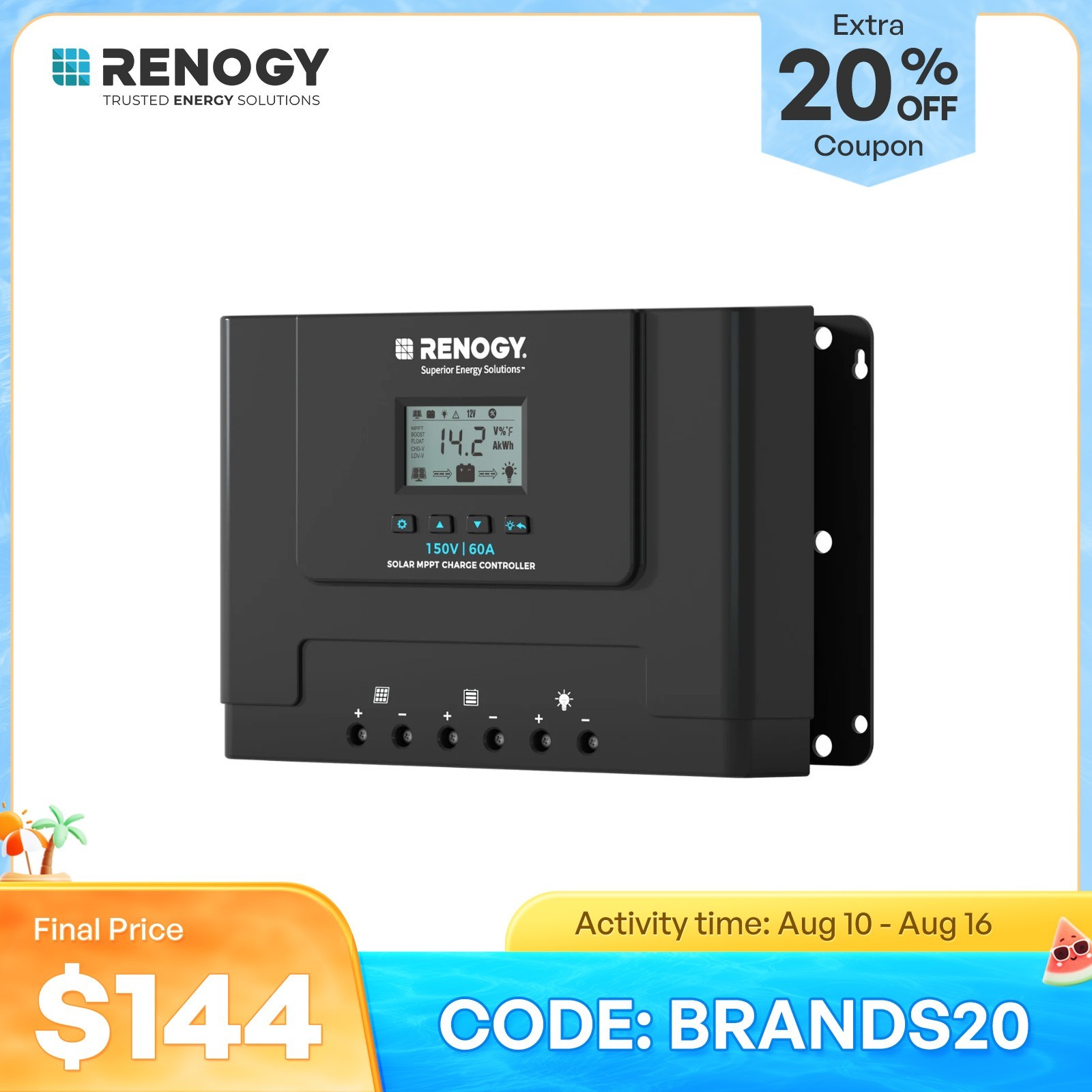
The concrete reason to choose this controller is the input capacity: the 150V max solar input and MPPT rating support a series-wired array without forcing you to run heavy parallel strings. The limitation to weigh is the USD 179.99 price: that cost only makes sense if your system can actually use the capacity, because a smaller array will never touch the controller's limits.
Bottom line
For an off-grid solar build that needs an MPPT controller with a high input-voltage ceiling, the Renogy Rover Lite is a strong balance-of-system choice. Match it to a battery bank that can accept the charge rate and a panel array that fits within the input limit, and you get a controller with enough range to grow into.