Choosing a solar charge controller for your balance-of-system is where an off-grid build either comes together or starts to get complicated. You need a controller that matches your battery voltage, delivers enough charge current, and doesn't make you guess about the rest of the setup. The Renogy Rover Lite and the IPANDEE 60A MPPT are two 60A MPPT controllers that both accept 12V/24V/36V/48V battery systems, but they point you in slightly different directions. The Renogy lists specific battery presets and a communication option; the IPANDEE gives you a higher max PV input and a lower price. The right choice depends on what you want to prioritize.
Quick verdict: If you want a 60A MPPT controller with named battery presets and RS485 communication, the Renogy Rover Lite at USD 179.99 is your pick. If you prefer a higher max PV input and a lower price, the IPANDEE 60A MPPT at USD 129.99 is the one.
| Product | Price | Max solar input | Standout detail |
|---|---|---|---|
| Renogy Rover Lite | USD 179.99 | 150V | AGM, Gel, Flooded, Lithium-iron Phosphate, and User Custom presets plus RS485 |
| IPANDEE 60A MPPT | USD 129.99 | 200V | LCD display, LED indicator, and 3120W max input power |
Where each product wins:
- The Renogy Rover Lite wins when battery chemistry clarity is the priority. Its named preset options let you set the charging profile instead of guessing.
- The IPANDEE 60A MPPT wins when you want more voltage headroom for longer series strings of panels.
Renogy Rover Lite 12V/24V/36V/48V 60A MPPT Solar Charge Controller
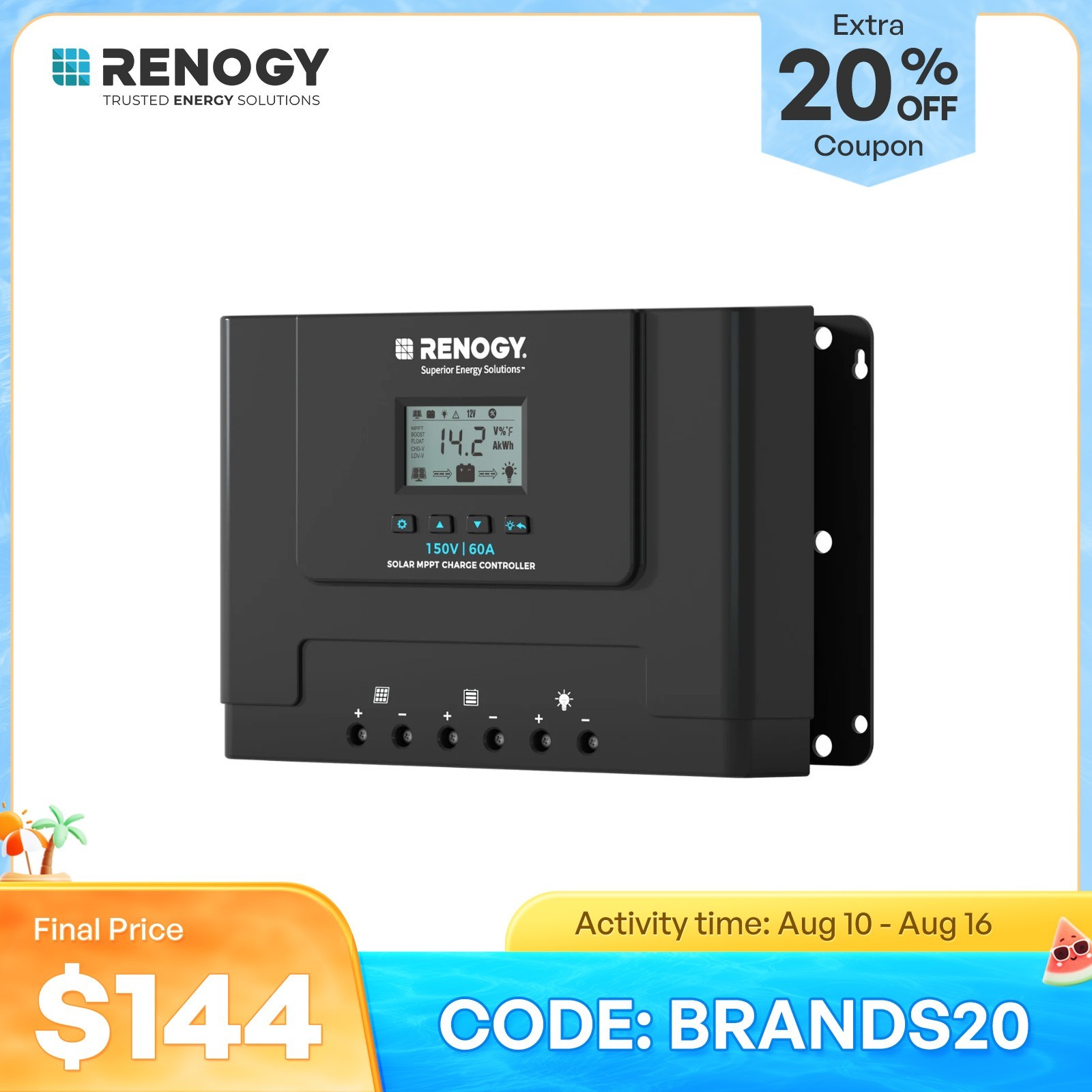
The Renogy Rover Lite is the controller that makes battery setup explicit. It lists AGM, Gel, Flooded, Lithium-iron Phosphate, and User Custom presets, so you can match the charging behavior to the battery you actually own rather than relying on a generic curve. A 150V max solar input suits a string like six 200W panels in series, and the conversion efficiency is rated above 97%. The limitation is that 150V input ceiling: if you plan to run a considerably higher-voltage array, the Renogy will be the limit you have to design around. That setup precision is the main reason to choose it over a less specific controller.
IPANDEE 60A MPPT Solar Charge Controller for 12V/24V/36V/48V Battery Regulator
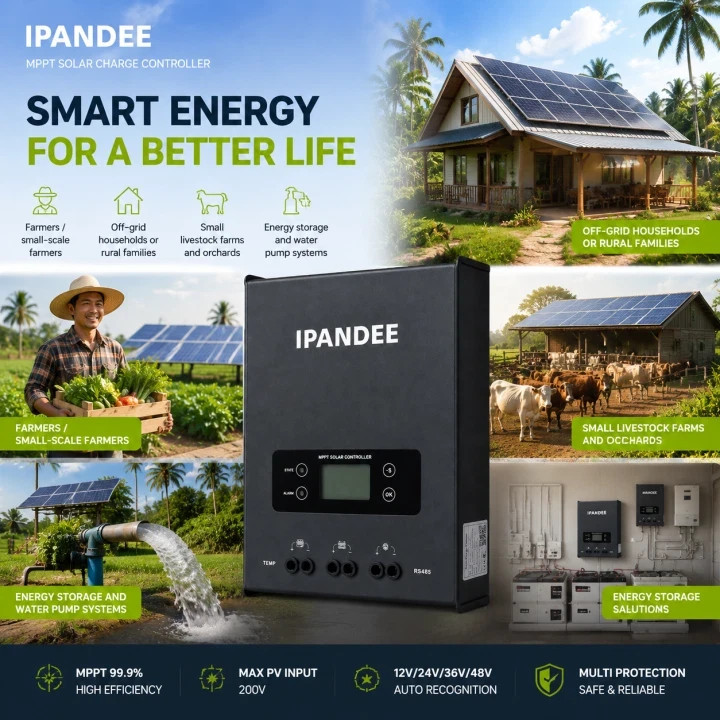
The IPANDEE takes a different route through the same 60A MPPT category. Its 200V max PV input is the higher ceiling in this pairing, which helps when your solar array needs longer series strings of panels. The listed applications include home, garden, marine, and shed uses, and the maximum input power is stated at 3120W, so you know the capacity boundary before you build. An LCD display and LED indicators keep the charging state visible, and the MPPT charging mode is the central feature. The limitation is that 3120W maximum input power is a fixed number; if you later want to add a lot more panel capacity, that ceiling will be the deciding factor.
Final choice by use case:
Choose the Renogy Rover Lite when preset-level battery setup is what you need. Choose the IPANDEE 60A MPPT when a higher PV input ceiling matters more for your panel layout.